Points Miles and Bling (blog) contains referral or affiliate links. The blog receives a small commission at no additional cost to you. Thank you for your continued support. Credit Card issuers are not responsible for maintaining or monitoring the accuracy of information on this website. For full details, current product information, and Terms and Conditions, click the link included.
I used to get really nervous during turbulence. But now weirdly, I kind of enjoy it. It eventually stopped feeling like a threat and started feeling like being on a boat or driving down a bumpy road. That said, I do tend to get flashes of anxiety if turbulence gets really rough.
I think it’s both reasonable and common to understand aviation, trust the statistics, fly often, yet still feel anxious sometimes. Flight anxiety is incredibly common. Flying puts you in a very specific situation: you’re strapped in, you’re thousands of feet in the air, you’re not in control, and you can’t just leave.
Many of us know that commercial aviation is one of the safest forms of transportation. Statistically, we’re far more likely to be injured in a car accident than in a plane crash. But it can be easy to forget at 35,000 feet.
Part of the reason flying feels scarier than it is, is because we hear about every plane crash. They’re so rare that when they do happen, they make major headlines. Car accidents happen constantly but they don’t make national news.
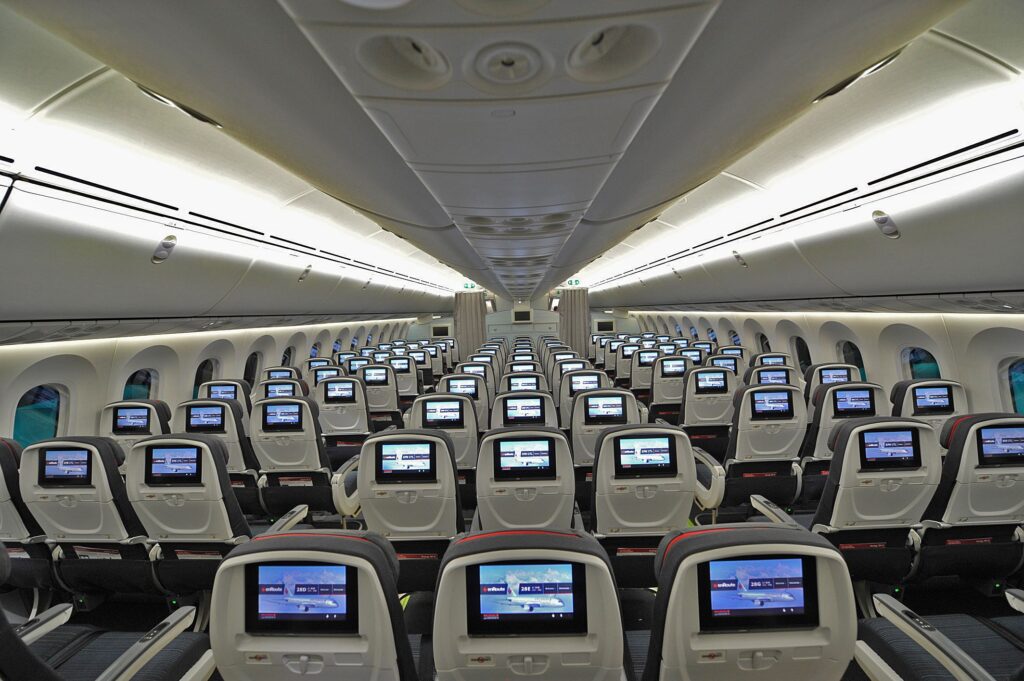
Economy Cabin
Turbulence
For many nervous flyers, turbulence is the main trigger.
Last year, I listened to a podcast where journalist, Liz Moody, interviewed pilot, Kyle Koukol. Hearing him explain the causes of turbulence, how pilots manage it, and why it’s nothing to be afraid of, made a world of difference for me. Understanding what was actually happening took away the mystery, and with it, most of the fear.
Kyle explained turbulence as simply being irregular movement of air. Think of it like driving over a bumpy road or floating on waves; the air is just moving in different directions and at different speeds.
There are several types of turbulence. The first is clear-air turbulence, which happens in cloudless skies due to wind speed changes. The second is thermal turbulence, which is caused by rising warm air. The third is mechanical turbulence, which is created when air flows over mountains or buildings. All of these are normal atmospheric conditions.
Planes are designed specifically to handle these movements. In fact, aircraft wings are built to flex (sometimes dramatically) without damage. What can feel like a dramatic drop inside the cabin is often just a small shift in airflow. Kyle reassured that turbulence will not bring a plane down nor break a plane apart.
Pilots are not scared of turbulence. You’ve probably noticed that before takeoff, they’ll often tell you whether to expect a smooth ride or some bumps along the way. They have access to radar, weather systems, route data, and reports from aircraft flying ahead of you. And when planes change altitude during turbulence, it’s for comfort, not survival. They’re looking for smoother air because it makes for a better ride for passengers and crew.
What Helped Me With Flight Anxiety
One thought in particular that has helped me whenever I find myself nervous on a flight: there is nothing I can do that will change the outcome. Worrying won’t make the flight smoother. So I might as well just chill.
There’s something freeing about accepting that. I am not flying the plane, highly trained professionals are. The aircraft is engineered for this.
Another small tip: watch the flight attendants. If they’re calm, chatting, or casually doing service during light turbulence, everything is fine. They do this every day. If they’re not worried, you probably don’t need to be either.

2 comments
I like to ask people a trivia question at times:
Q: How many commercial jetliners have crashed due to turbulence?
A: The same number as successful widebody water landings: Zero.
That doesn’t provide much comfort about water landings but it tends to calm people about turbulence. My only question about turbulence is how the pilots don’t suddenly jerk the controls in response, which might make things more unpleasant.
Worst part about turbulence is needing to hold your drink cup lest you have a lapful of drink if it was full.