
Points Miles and Bling (blog) contains referral or affiliate links. The blog receives a small commission at no additional cost to you. Thank you for your continued support. Credit Card issuers are not responsible for maintaining or monitoring the accuracy of information on this website. For full details, current product information, and Terms and Conditions, click the link included.
Award travel should feel like freedom: the chance to take trips you wouldn’t normally justify paying cash for, on flights you actually want, on dates that suit your life. In reality, most of us experience two conflicting urges during the booking process. One is the desire to minimize costs by maximizing point use, and the other is the impulse to say “forget it,” YOLO, and book the more comfortable, easier option so we can move on, which leads to overspending. This internal tug-of-war is common among points and miles enthusiasts and can cause poor decisions if followed blindly.
During my brief break from PMB writing, I reflected on how my behaviour in the points hobby has changed. I’ve gone through the full maximizer routine: spreadsheets, CPP calculations, saver hunting; the whole “my brain is melting” experience. Recently, I’ve found myself doing the opposite, dropping 250,000 points on a one-way long-haul simply because I can and earning more points feels effortless. That’s the problem. Earning points easily can make you complacent, and I’m striving to find a balance where I’m neither overly frugal nor wasteful with my points.
In this post, I’ll break down these two extremes and share the framework I use to stay in the middle.
Maximizing Award Flights
Social media, especially Instagram, has been gaslighting people about the true cost of premium-cabin awards. One of the main reasons I wanted to write this article was to share my frustration at seeing “dirt cheap” business and first-class redemptions presented as if they’re normal. Most of those posts leave out the fine print. The price often assumes a current transfer bonus, unusually good award availability, and a perfect combination of dates and routing. For 99% of viewers scrolling, replicating that exact booking is either unrealistic or impossible.

Example of how social media shows the result, not the conditions required to book it.
When you’ve seen enough of this content, it rewires your expectations. It sets a false baseline for what awards “should” cost, and it nudges you into a maximizing mindset where anything above that number feels like a failure. After all, this is how most people start in the points hobby. You learn about saver awards, sweet spots, partner charts, distance bands, stopovers, and Cents Per Point (CPP). Doesn’t it feel like you’ve cracked a code? And, let’s be honest, it’s fun! However, there is a dark side to it; if you’re not careful, you stop prioritizing the trip and focus solely on the numbers. That’s when the points game quietly begins making travel worse. With that, let’s examine five ways that maximizing can create a false sense of success.
1) Saving money by making the itinerary fragile
One of the most common “maximizer” moves is minimizing fees at all costs. On paper, it looks smart: lower taxes, lower surcharges, and lower out-of-pocket costs. The problem is what people do to accomplish this. Positioning to another airport, adding extra connections, or stitching together separate tickets can absolutely reduce taxes. It can also increase the risk that the whole trip will fall apart. Weather delays, missed connections, baggage issues, and IRROPS stop being annoying inconveniences and start becoming real threats, especially when segments are on separate bookings, or you’re trying to catch that aspirational first-class flight.
Saving $200–$300 in fees sounds great until it costs you half a day, extra hotel nights, or a blown itinerary. At that point, you didn’t save money. You just paid in time, sanity, and risk.

Etihad First Class Apartments – Is being overly frugal worth missing this flight
2) Routing gymnastics, distance bands, and stopovers you didn’t even want
This is where maximizing starts to feel like a video game. People build itineraries to squeeze every last mile out of an award chart. They fly to the edge of a distance band just because the pricing is “better.” They add stopovers because they can, not because they genuinely want them. Here’s a sample booking I made with 16 flights, 3 stopovers, and multiple ~23-hour transits.
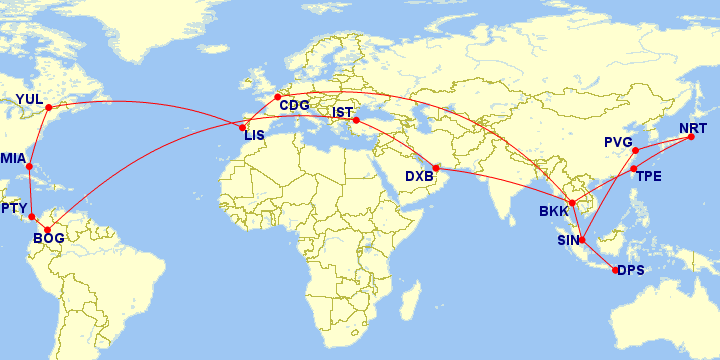
Maximizing Aeroplan: Mini RTW trip booked in the old Aeroplan program with 16 segments
Why did I book this? Simple, because I wanted to maximize and feel accomplished with this creative trip I came up with. Was it stupid and a waste of time in hindsight? 100%. Sure, I had free stopovers and long transits, but it came at the cost of extra vacation days, more time at the airport, and extra logistics.
Here’s the gut check I always come back to today: would I recommend this routing to a friend? If you’d feel weird recommending it, that’s a sign you’re doing it for the points win.
3) The CPP Obsession
CPP (Cents Per Point) is a metric used in award travel to determine whether a redemption is a good or poor value. The calculation is simple: divide the cash price of a flight/hotel by the points required.
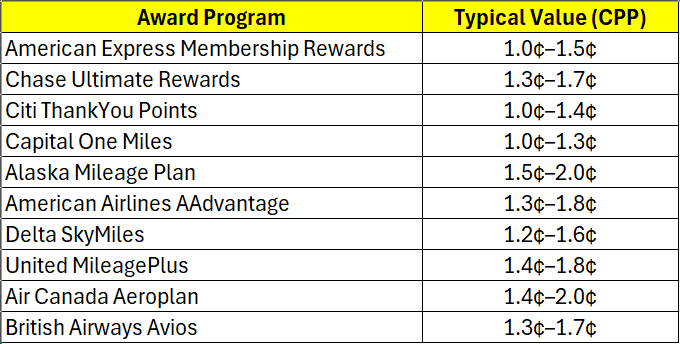
Example CPP valuations
While I believe these “currency” valuations are helpful for newcomers to the points hobby to assess whether their redemptions are worthwhile, they are misleading and do not reflect reality for two main reasons.
- The valuation method doesn’t take into account whether the cash price of your award is artificially inflated, which it often is
- The savings are hypothetical. If you would never pay $20,000 for a first-class ticket, then thinking about CPP is illogical.
Here is my take: CPP should be used only as a floor to avoid bad redemptions, and that is how I use it. A “good” redemption should prioritize convenience, destination, and experience over a high mathematical number. Get out of the mindset of maximizing the CPP, and to any influencers reading this, stop flexing your CPP; you have not unlocked any treasure chest.
Just remember, points are a currency, yes. But a redemption isn’t just a number. It’s a travel day.
4) The Saver Trap: chasing unicorn availability
Learning about points and miles is easy. Earning points is easy, too. Redeeming? Well, that becomes exponentially more complicated as you aim for higher and higher premium cabins, and it is a trap that newcomers to the hobby don’t realize and often fall into. They are drawn into these theoretical possibilities with their points because they were influenced by watching an influencer on social media. This is a serious problem, and it really saddens me to see newcomers being set up for failure. I wish the experts would be more open and transparent about how they booked their award flights, rather than focusing on eye-catching headlines like:
- “Treated like a king in Etihad First Class for just $800.”
- The currency, points needed, award program, and restrictions are all omitted
- “I flew Qsuites for just 54K Amex points!”
- Route, Saver price, booking difficulty, and transfer bonus are omitted.
- “Took my family of 6 in Swiss business class!”
- Taxes, route, and married segment logic are omitted.
Most of these so-called “amazing” award redemptions are great when they are available for your dates, and you’re aware of how to book them, especially if you can combine a transfer bonus from a credit card points program. But if you focus only on that “unicorn” price you saw online, anything above it can start to seem like a rip-off.

Here’s the brutal truth: unless you’re fairly advanced and have invested time into learning award release schedules, patterns, industry news, and the tools, you may simply never see that saver price that influenced you. A redemption you can’t realistically book yourself isn’t a benchmark. It’s a fantasy baseline. This is where the always-wanting-to-save-and-maximize mindset quietly turns into paralysis. You’re optimizing a trip you haven’t even booked yet.
5) The hidden cost of maximizing: time, sanity, and risk
Here’s what rarely gets quantified: the effort behind maximizing. The time spent searching, the mental bandwidth it drains, and the self-inflicted chaos it can create are real; I have experienced it. And, for what? The measly 20,000 points I saved? Should I ignore the two added connections, a positioning flight, and a six-hour layover? The math looks great, but this travel day looks painful.

Maximizing can be smart. But maximizing at all costs is how you end up optimizing a number rather than your trip.
Overpaying for Award Flights
On the other end of the spectrum is the mindset of always overpaying for award flights. It’s the impulse to just book the best option without much thought or analysis. While it can sometimes be the best choice when convenience, sleep, fewer connections, and/or your sanity are at stake, it also has its own failure mode. If you don’t pause to sanity-check the trade-off, it can quietly turn into overspending. The result is that you no longer pay for meaningful improvements to your travel experience but rather pay a massive premium for marginal gains. And if you care about CPP, you’ve probably hit a number that’s outright embarrassing.
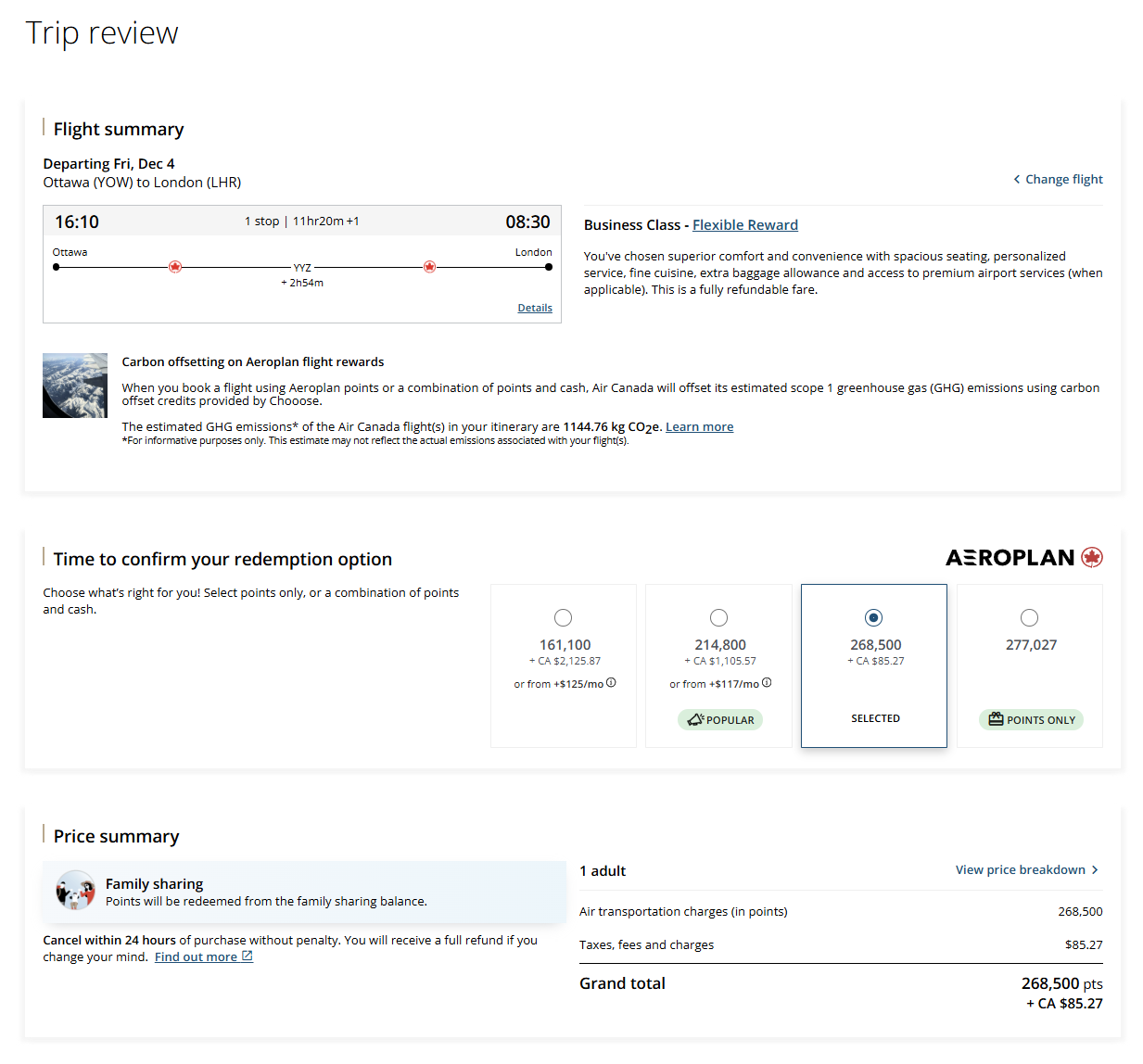
Example of overspending on an award flight redemption through Aeroplan
Here are the most common ways people set themselves up to be wasteful with their points:
- Booking premium cabins when the flight is too short to matter: Not every segment needs business or first. Premium is most worth it when it changes the outcome, like when rest is needed on a long-haul flight to ensure you arrive functional and, as a result, reduce fatigue in a meaningful way.
- Overspending for marginal gains: Comfort creep is real, but there’s a point where you’re paying double or triple the points for a slightly nicer seat, a slightly better schedule, or a slightly better product.
- Treating nonstop as a blank cheque: Nonstop can absolutely be worth paying for, but it isn’t automatically worth any price, especially when a clean one-stop gets you there with minimal extra pain
- Forgetting who you’re travelling with. Your redemption math changes when you have a partner or family member who hates connections or gets anxious flying. Sometimes spending more points is worth it for the group, and sometimes it isn’t
- Using “points devalue” as permission to torch points. Yes, devaluations happen, and life gets in the way. That’s a reason to use points, not hoard them forever. But it’s not an excuse to overpay every time without thinking.
Think about whether you have ever fallen into one of these 5 traps?
The Middle Ground: A Redemption Strategy That Works
If maximizing for award flights is about winning with the lowest numbers, and overpaying is about pressing the easy button, then the middle ground is about being intentional with your points. The idea is not always to pay the least, but you are also not trying to ball out every time. You want to book the option that is worth it for you on this trip. The simplest way I see it is that every award flight booking is made up of three currencies:
- Points
- Cash (taxes, fees, positioning costs, hotels from awkward routings)
- Time + sanity + risk (connections, missed bags, IRROPS exposure, fatigue, stress)
The third currency is rarely considered, and if you try to assign a value to your time, sanity, and risk tolerance, you start to create a picture of what the ideal redemption looks like for you.

Finding your redemption that is worth it for you
Here’s a quick checklist that might help you find the redemption that is worth it for you:
Spend more when it buys a real outcome:
- Fewer segments and fewer failure points
- A schedule that saves a travel day or protects your sleep
- Less fragility (especially avoiding separate-ticket stress)
- A meaningful cabin upgrade on a flight where it really matters
- A smoother experience for the people travelling with you
Spend less when it’s diminishing returns:
- The flight is too short for premium to make a difference
- You’re paying a massive premium for a marginal improvement
- The “better” option doesn’t actually reduce risk or stress
- You’re doing it for the label, not the outcome
Summary
At the end of the day, this hobby isn’t about winning the spreadsheet or proving you can book the most “insane” redemption. Maximizing or overpaying for award flights can both make sense and can be useful in the right moments. The problem is when either one becomes your default, and you stop thinking about what the trip actually costs in terms of time, stress, and trade-offs.
So here’s my personal rule of thumb. If saving 20,000 points costs me half a day, adds two connections, or turns the itinerary into a fragile puzzle, it’s not a win. On the flip side, if spending an extra 80,000 points doesn’t materially change the trip, that’s not worth it either. The middle ground is where your redemption supports the trip you’re trying to take, not the story you’re trying to tell. Book the trip. Not the ego.

1 comment
I agree mostly. I will say with the routings though – one of the best ways to become “well-travelled” is to be open to any option that lets you maximise time using your resources, and a great way to do this is to chase award space, even if it means more stopovers. I’ve been to many places (Istanbul, Frankfurt, Madrid, Shanghai come to mind) that I otherwise wouldn’t have been if an award seat/cheap flight hadn’t opened up that went through these cities.