
Points Miles and Bling (blog) contains referral or affiliate links. The blog receives a small commission at no additional cost to you. Thank you for your continued support. Credit Card issuers are not responsible for maintaining or monitoring the accuracy of information on this website. For full details, current product information, and Terms and Conditions, click the link included.
Work travel isn’t as glamorous as it looks on Instagram. It’s early alarms, airport dinners, back-to-back meetings, living out of a suitcase, and minimal sightseeing. Most trips are airport – hotel – meetings – repeat. But it does offer major perks. You get to see the world on someone else’s dime, and when approached strategically, it can become a points goldmine.
Over the last three years, I’ve funded about 90% of my personal travel through points earned on work trips, including vacations to Spain & Portugal, Nashville, Victoria, Mexico City, Japan, and Canmore.
I started earning significantly more points once I became intentional about every booking.
Hotels – Marriott Bonvoy
For work travel, I’m loyal to the Marriott brand. No matter where I travel, there’s almost always a Marriott property, and in major cities, there are multiple brands at different price points. Even the lower-tier properties are perfectly comfortable for business travel, in my opinion.
Through staying loyal to Marriott, I’ve earned: Platinum Elite Status, elite night credits, bonus points on paid stays, and status perks that make work travel easier and more comfortable, like late checkout, room upgrades and lounge access when available.
Last year, I got the Marriott Bonvoy American Express Card, which now comes with up to 110,000 bonus points. With 25 hotel nights booked for work within my first two months of holding the card, hitting that threshold was easy. If you’re a frequent business traveller and already loyal to Marriott, I recommend getting this card right before a big trip or a period of heavy travel so you can easily hit the minimum spend and maximize the welcome bonus.
The card also comes with an annual Free Night Award and 15 Elite Night Credits each year. That means I start the year already 15 nights closer to re-qualifying for Platinum status (so I only need 35 more qualifying nights). With a $120 annual fee, the card more than pays for itself if you redeem the Free Night Award for a stay worth $120 or more, which is not hard to do.
On top of that, I earn 5x points per dollar on Marriott stays through the card, in addition to the base and elite bonus points earned from Marriott directly.
For a frequent business traveler, it’s an easy way to stack points and accelerate status without changing anything about my travel schedule.

Residence Inn, Kuwait
Airlines – Air Canada
With regards to flights, I’ve historically been loyal to Air Canada. Before learning more about the points strategy, my loyalty was mostly convenience-based. But flying consistently with Air Canada allowed me to earn Aeroplan 35K status, though I’ve always chased 50K, simply for the lounge access.
For work trips, previous company policy only allowed Economy Flex fares, which meant long-haul flights like Vancouver to Shanghai and Toronto to Dubai were unpleasant to say the least.
But status helped. Through earning Status, I unlocked eUpgrade credits, priority check-in and boarding, priority baggage, additional baggage allowance, and a handful of one-time Maple Leaf Lounge passes. Though the only things I’ve really ever cared about are the eUpgrade credits and lounge passes. Every so often, I clear into Premium Economy, which makes those long-haul flights significantly more bearable (read my DXB – YYZ Premium Economy review here).
Another perk of 35K status is the 50% off Aeroplan flight reward benefit on eligible round-trip bookings within North America. I’ve used that perk to book YYZ – BNA, YYZ – MEX, and YYZ – YYC, all at half the usual Aeroplan points cost.
For collecting Aeroplan points, I use my TD Aeroplan Visa Infinite card. That means I’m earning on the flight purchase itself and, of course, the Aeroplan points from flying.
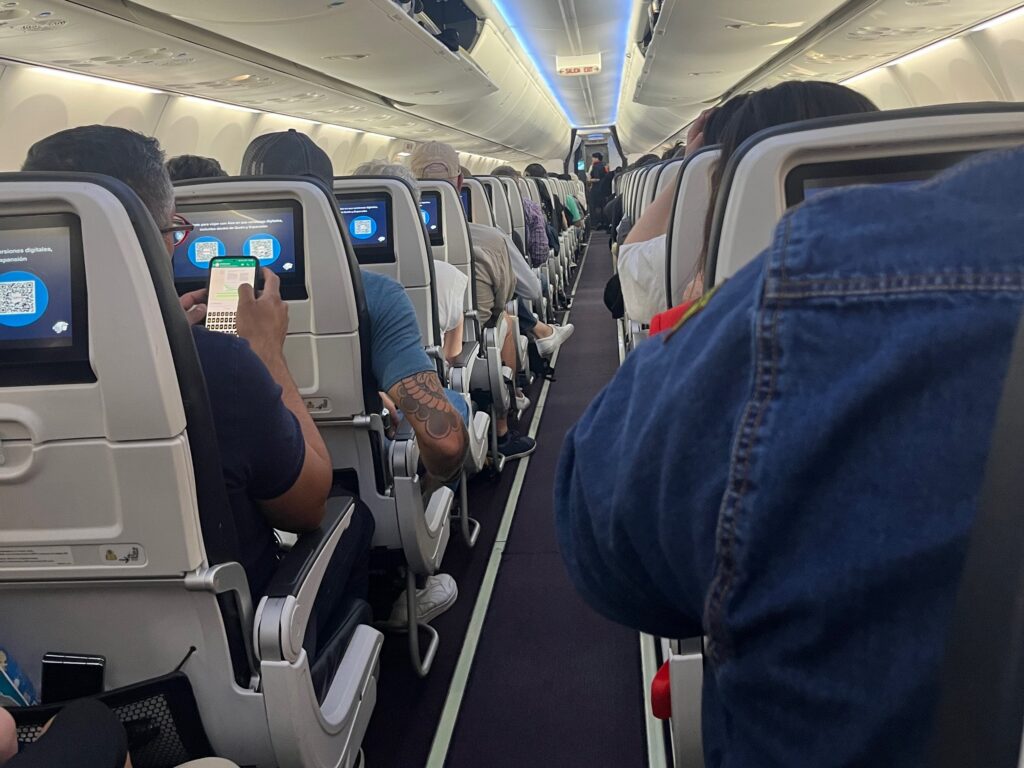
Air Canada Economy
Final Thoughts
The strategies I’ve shared are simply what have worked well for me, based on my organization’s travel policies, the routes I frequently fly, the hotel footprint in the cities I visit, and my personal travel goals. Your approach might look different depending on whether your employer books travel directly, limits airline choice, or restricts hotel brands.
I’ve learned that the key is to understand your own travel patterns and build a strategy around them. Once I stopped booking passively and started thinking about ecosystems, status qualification, and stacking opportunities, my work trips became more than just work. They became the engine behind my personal travel.
Work travel may not feel like a vacation, but when done strategically, it often makes the vacation possible.

Vacation in Playa Del Carmen, Mexico