
Points Miles and Bling (blog) contains referral or affiliate links. The blog receives a small commission at no additional cost to you. Thank you for your continued support. Credit Card issuers are not responsible for maintaining or monitoring the accuracy of information on this website. For full details, current product information, and Terms and Conditions, click the link included.
Like me, if you have been doomscrolling through the situation unfolding in the Middle East, you know how things have deteriorated rapidly following the escalation of the U.S.–Israel–Iran conflict. Multiple airspaces have been restricted or closed outright, airports across the region have suspended operations, and thousands of travellers have found themselves unable to leave despite holding valid tickets and confirmed onward plans.
The Abu Dhabi Department of Culture and Tourism (DCT) has issued a circular instructing all hotel establishments to extend the stay of guests who were due to check out but are unable to depart due to circumstances beyond their control. Crucially, the cost of these extended stays will be covered by DCT Abu Dhabi, with hotels permitted to submit invoices directly for reimbursement. Clutch move, all class.
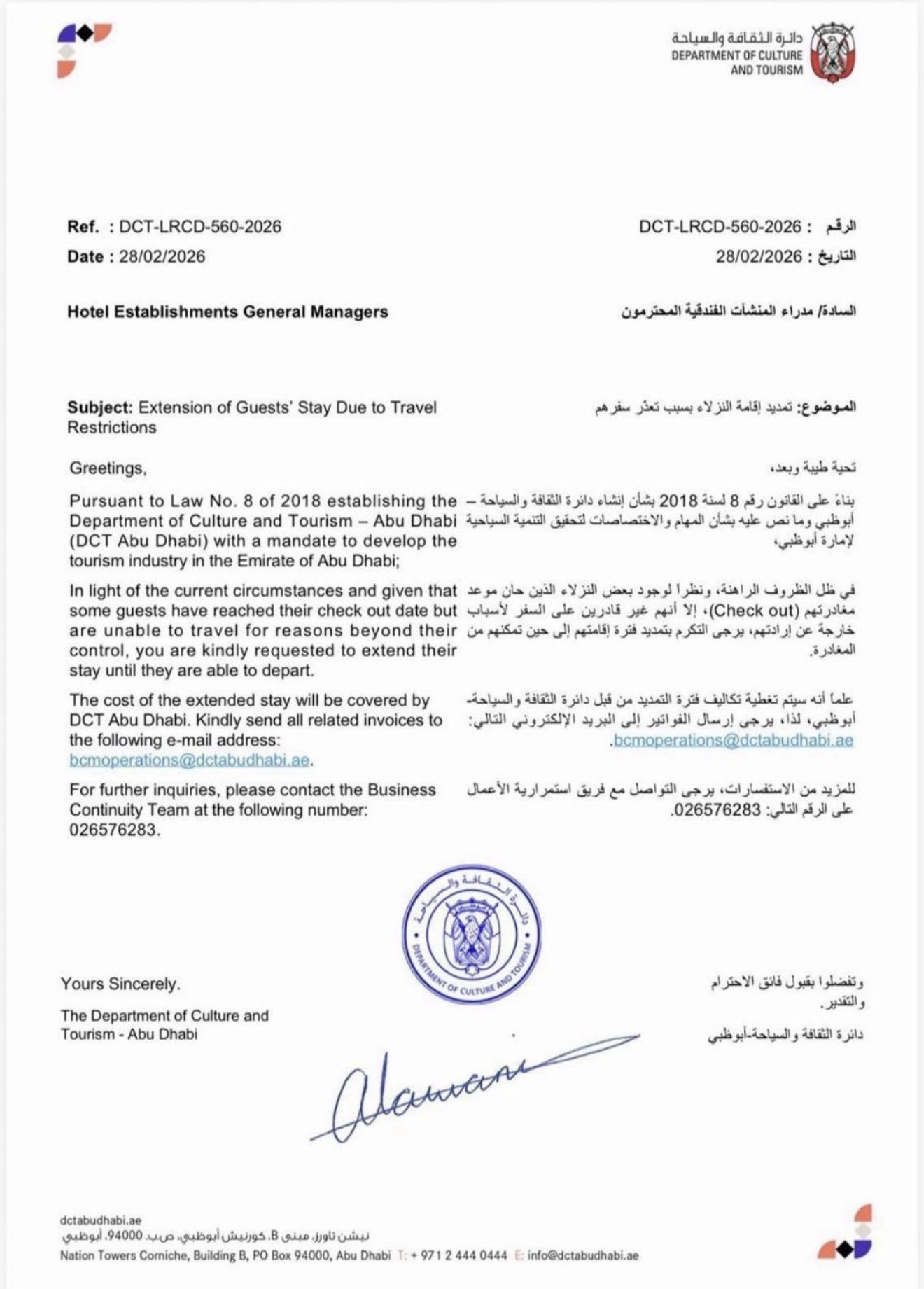
Abu Dhabi DCT Circular – via @jyotsnamohan on X
The circular does not explicitly address airline obligations, but in most cases, airlines are expected to rebook passengers with confirmed tickets once operations resume. That said, recent history has shown that during large-scale disruptions, support can be slow to materialize. In contrast, the Abu Dhabi approach is proactive and ensures that people have a place to stay while larger logistical challenges are worked through.
In an era where crisis responses often default to fragmented policies, fine print, or market-driven pricing that disadvantage those most affected, this move by Abu Dhabi is rooted in accountability and humanity.
As the situation in the region continues to evolve, I hope other governments can muster the funds to help those stranded as well. It is a reminder that leadership is ultimately measured by how systems protect people when conditions are at their most fragile.
