Points Miles and Bling (blog) contains referral or affiliate links. The blog receives a small commission at no additional cost to you. Thank you for your continued support. Credit Card issuers are not responsible for maintaining or monitoring the accuracy of information on this website. For full details, current product information, and Terms and Conditions, click the link included.
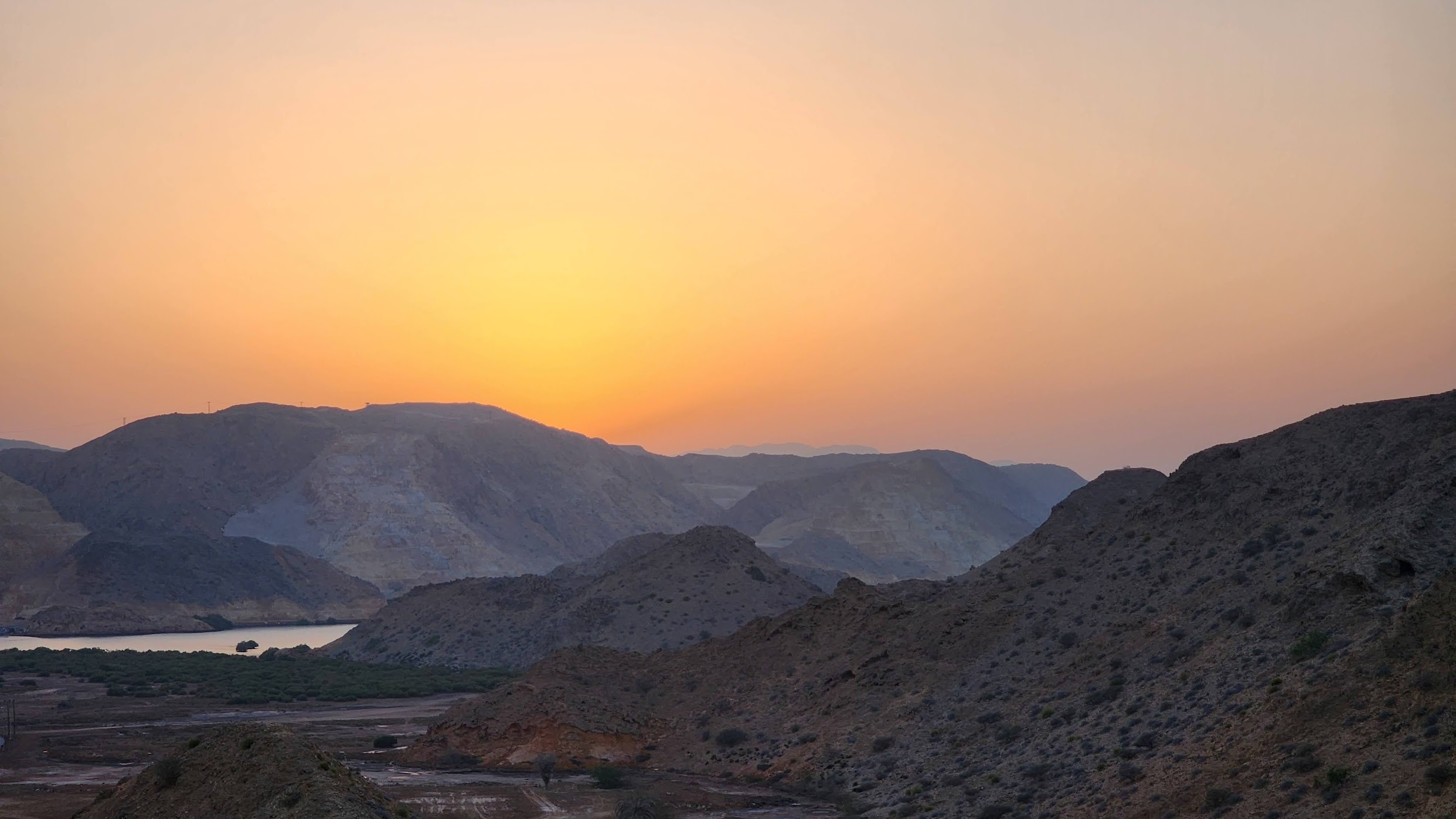
In early January, my daughter, currently working in France, mentioned she had a week off in late February. Never one to let a travel opportunity slide, I tapped into my “points prowess” to bridge the gap between us. Since February in Europe feels a bit drab, I set my sights on somewhere warm with an emphasis on great outdoor adventures. Europe to the Middle East is a great award sweet spot, with 7+ hour-long-haul flights for just 45k points in many programs on some fantastic Middle Eastern airlines. Our goal for the week? Hiking, swimming, and some serious resort “chill time” in Oman. Muscat exceeded every expectation, and we spent an incredible week at St. Regis Al Mouj Muscat doing all of the above-mentioned activities.
When it came time to wrap up our holidays together, getting my daughter back to France required some creativity. I booked her a Muscat–Doha–Casablanca–France route for just 45k American miles in Business Class. Little did I know this would turn into a massive headache, as I at least wanted to join her on the short Muscat-Doha hop, and for me, this was also a potential opportunity, as I could finally visit Qatar too. I planned to spend a day in Qatar before heading to Abu Dhabi on a separate ticket. This opportunity would allow me to finally experience the legendary Al Safwa First Class Lounge. I used 20k Qatar Avios to book a “Domestic First Class” leg from Doha to Abu Dhabi.
Tourist Day and a Missile Interruption
Rather than risking a midnight layover at Doha airport when the lounge’s sleeping pods would most likely be full, I booked the Hyatt Regency Oryx, a Category 1 gem just two subway stops from the airport. It offered fantastic value and a solid Regency Club.
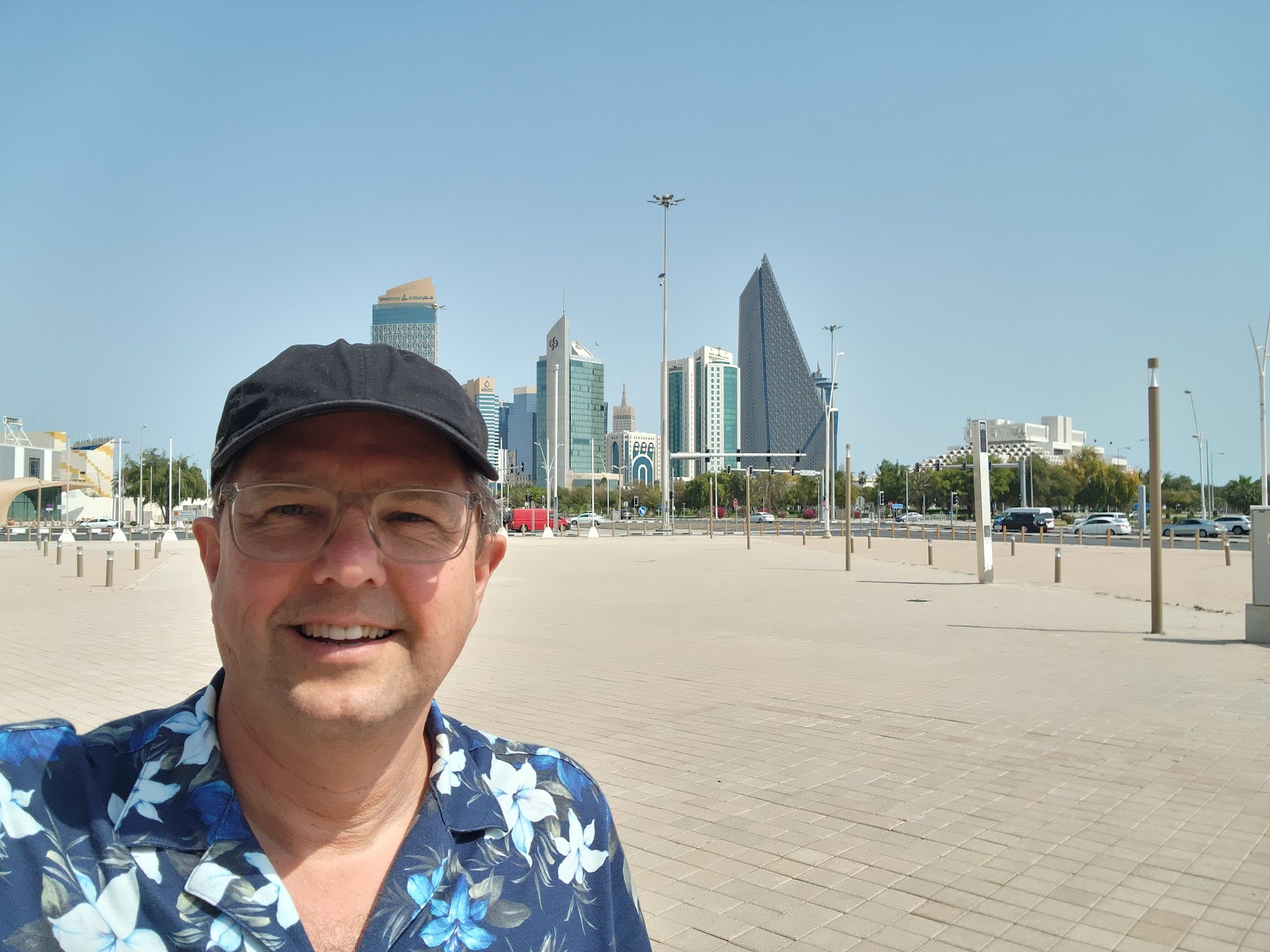
A “Tourist Day” In Doha
The morning started like any other travel day. I hopped on the Doha subway, eager to explore. I’d heard some distant rumbling earlier that morning, but I’d slept through most of it and didn’t give it a second thought. I was naive enough to think Qatar was immune to the region’s tensions. That changed fast. As I wandered toward Souq Waqif, an emergency alert blared on my phone in Arabic. I dismissed it as a routine test. Fifteen minutes later, the alert screamed again. This time, every tourist in the marketplace received it simultaneously. I watched the color drain from the faces around me.
The message was chilling: “All individuals are urged to strictly remain in their homes or in a safe location and not leave except in cases of absolute necessity until the danger has passed.”
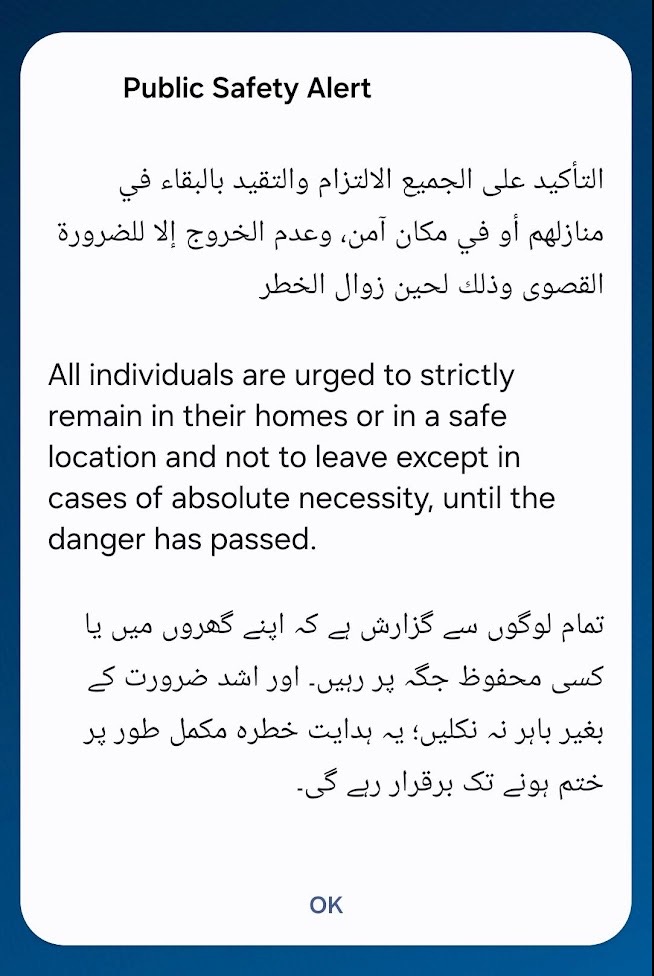
Public Safety Alert in Qatar
I flagged the first taxi I saw and raced back to my hotel to grab my belongings before my 4:00 pm checkout. The reality sets in. I messaged my wife: “Oh no, [expletive]! I just heard a bomb explode. I’m in a taxi heading to the hotel.” She told me later that seeing me swear in a text at 3 am made her heart stop; she knew immediately that something was very wrong. Back in my room, the news confirmed the worst: missile strikes had been intercepted over Qatar and other locations across the Middle East.
The hotel lobby was pure chaos. A shuttle bus had just dropped off a swarm of diverted passengers, and the front desk was overwhelmed. I handed my key to a bellman, who coordinated with a manager to check me out remotely. I hopped onto an airport shuttle, the only passenger on a 40-seat bus, and headed into the unknown.
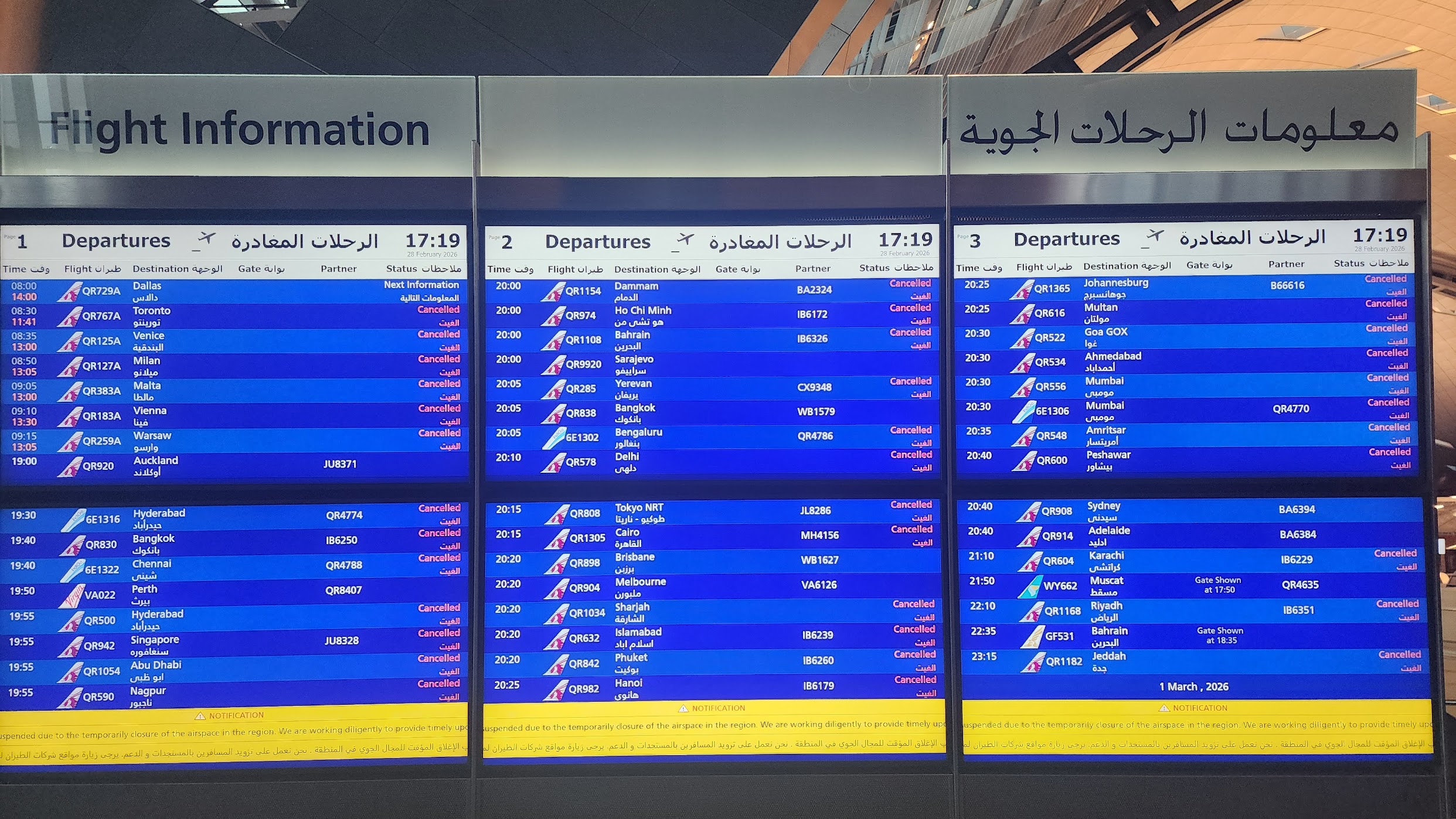
Flight Information Monitoring in Doha
At the airport, I went to first-class check-in, hoping it might just be a 12-hour delay and that, with a first-class ticket, they might give me more details and possibly a hotel voucher (even though I knew this was obviously not within their control). Unfortunately, the agent told me to install the Qatar app, as airline operations would be communicated through it, and that the airport was now closed, with an announcement at 9 am to let passengers know what to expect next. Not exactly the response that I had hoped for, I hopped onto airport wifi with my laptop and looked at hotel options for that night. The hotel I was staying at was sold out, but to my surprise, the Park Hyatt Doha was still available and at quite a reasonable rate. Because I had purchased a subway day pass and had actually walked right by the Park Hyatt on my way to the Souq Waqif, I pressed the book button and headed to the subway station at Doha airport. I took the subway back into the city, retracing the steps I’d taken only hours earlier.
The Hyatt staff were incredible. Despite being down to their last two rooms, they tucked me away on a high floor. I spent the night glued to the news and checking in with my wife. One thing I would like to mention about travel is that in moments of crisis, reliable communication is everything. My Freedom Mobile “Roam Beyond” plan was a lifesaver, unlimited calls and 5GB of data meant I could stay connected to home without worrying about a massive bill or hunting for local SIMs. For my travel in Oman, one of the few countries that is not covered, I use the Saily eSIM, and for just a few dollars, I was connected and can use Google Maps and WhatsApp to communicate with those back home.
Canadian Consulate and the Land Border into Saudi Arabia
Again, got my laptop up and followed the news, and by now it was approaching 7 am back home, so I decided to phone my wife even though I knew that she would have had a rather restless sleep. I really did not know much more by then, so I just decided to eat some dinner and go to bed, and asked my wife to let me know what she could find out while I slept, and I would regroup a few hours later when I woke up. She reached out to many of our friends, who all wanted to know how I was doing. They also did some research and gave me the email address and contact information for the consulate in Qatar, along with updates from their end. What I noticed and told them as I went out to breakfast was that all the staff at the Hyatt had shown up to work, and that in the restaurant, the staff all seemed calm. This was so reassuring to me as I really had no idea what the danger level was. Obviously, if the staff were showing up and service was still outstanding, that had to be a sign that things were probably not as bad as I was making them out to be.
My outing to the consulate was a bust. When I got there, I got a message that they were closed. The email I had sent earlier said: “Thank you for contacting us. We are busier than normal and may not be able to contact you for a while.” Not the response I was hoping for, but my friends had told me there is a 24-hour Canadian consulate service that I could contact as well. So I drafted an email asking about crossing the land border into Saudi Arabia, as I noticed flights were operating as normal there. Fortunately, the Canadian consulate’s 24-hour emergency line got back to me within a couple of hours. So I headed back to the hotel and started to look for a place to stay that night. I now knew that this would not just be a 1-2-day delay, but an indefinite one that could last weeks.
As luck would have it, the Hyatt Regency Oryx, where I was staying, was available and at its low point rate of just 3500 points for a Category 1 hotel. On top of that, there is a promotion offering 3,000 points for every 3 nights. So this would work extremely well, as the net nightly cost would be about 2,500. As a points enthusiast, it always feels great when you get maximum value from your points, and this was a maximum-value redemption. Back to the other Hyatt I would go. The fellow Canadian traveler from Edmonton talked about a “tactical retreat.” His plan was bold, bordering on desperate: a 700km dash across the desert to the Saudi Arabian border. It felt like something out of a Cold War thriller.
Back at the Hyatt Regency Oryx, I had a full dinner in the Regency Club, which was fantastic. They had beef kabobs, hummus pitas, veggies, salads and more. Easily a place where you can make a dinner out of the club lounge. They actively sell club access at this hotel, and if you don’t have Globalist status, I would encourage people to book the Regency Club rooms.
Unfortunately, that night, my new friend from Edmonton had been texting me, and I had my phone on do-not-disturb mode, so I had missed his midnight texts. By the next morning, the adrenaline of the initial evacuation had faded, replaced by a heavy, vibrating tension. I sat by the hotel pool in the warm sunshine, but there was no relaxing. The rising wail of air raid sirens periodically shattered the silence of the empty city. Each one sent a jolt through my chest. This wasn’t a temporary glitch in a flight schedule; it was a city hunkering down for the unknown. I realized then that I couldn’t wait for the “all clear” from an app. I needed a way out, and I needed it now.
The Canadian consulate email said the land border was open and advised proceeding with caution, but recommended staying in Qatar and sheltering there. The entire Middle East was to avoid all travel. Yes, but now that I am here, what should I do? To me, Saudi Arabia looked like the best option, but the e-Visa website said it could take up to 2 days. I got a message back from the Edmontonian I met the day before, and he was already in Saudi Arabia. I started with the easy option and used United miles to book a Turkish Airlines flight from Saudi Arabia to Istanbul to begin the long journey home. I chose to use my United miles because the ticket was fully refundable if I didn’t make it to that flight.
Next, I pulled up the Saudi e-visa website. It felt like a gamble. I hit “submit” and held my breath. Ten minutes later, a ping. Approved. I had a legal path to the border, but no way to get there. In Qatar, the desert is a wall, and the only gate is the Saudi land border, a crossing most tourists never see and where no public buses travel. I managed to secure a private driver, a man who usually spent his days taking tourists on leisurely desert tours. Now, he was my extraction team.
The Hand-Off in No Man’s Land
The drive to the frontier was surreal; empty highways stretched toward a horizon that felt increasingly volatile. We reached the Qatari exit point, a well-organized border crossing. It was efficient, cold, and final. Once I was stamped out, there was no turning back.
But then came the catch. My Qatari driver couldn’t cross the line.
In a dusty, sun-scorched rest area in the “no man’s land” between nations, I was told to switch cars. I watched my luggage being moved into a beat-up sedan driven by a man I didn’t know, speaking a language I didn’t understand. My original driver gave me an encouraging look, told me to text him once I had cleared into Saudi, then performed a U-turn and disappeared back toward Doha.
I was alone in the desert, thousands of miles from home, handing my passport and my safety over to a stranger. We drove to the next town, and the new driver asked if his brother could come. I reluctantly agreed, but texted the tour operator driver in Qatar who had taken me to the border.
He replied with “wow changed driver ? okay. But only pay in when your reach there Riyadh airport.” and then said “yeah, he didn’t mention that. But it’s okay. Both countries are so safe. No anyone can’t cheat.”
This really relaxed me, and it is an important point I would like to make. Qatar and Saudi Arabia are very safe countries. Although I personally do not agree with some of their laws, one thing that really stands out is how safe tourists are. Obviously, you need to respect local laws as fines for violating safety regulations are very strict. I feel much safer walking down any street there at 2 am than in many places I have travelled, such as downtown Chicago or Seattle, where you are not safe. Given the limited time I spent in Qatar and Saudi Arabia, I by no means believe I am an authority on this, but this is just what I observed.
The five-hour journey to Riyadh should have felt like an eternity of anxiety. Instead, it became a profound lesson in the quiet power of human kindness. My driver and I existed in two different worlds, separated by an insurmountable language barrier—until we opened our phones. Through the flickering screen of Google Translate, the silence of the desert was filled with our stories. There, in the middle of a geopolitical crisis, he looked after me like a brother. He shared his spicy Cheetos and sponge cakes, insistent that I was fed. He noticed my wonder at the camels wandering the dunes and, without a word of English, he pulled over, gesturing for me to take my photos, wanting me to capture the beauty of his home even in its darkest hour.
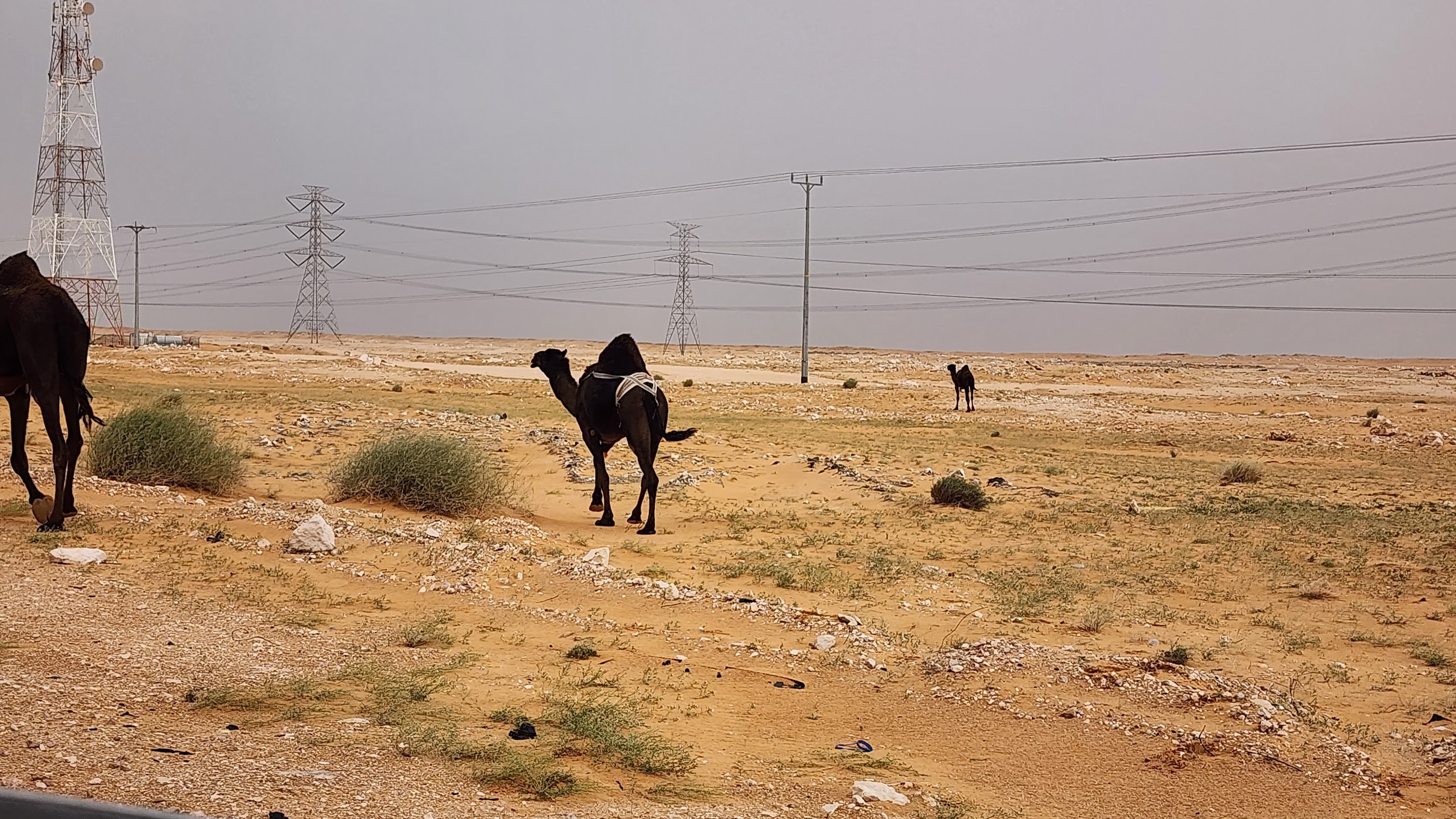
Camels in Saudi Arabia
When the glass towers of the Riyadh airport finally rose from the heat haze, a beacon of safety in a grounded world, the moment of parting caught me off guard. He didn’t just unload my bags and wait for payment. He stepped toward me and pulled me into a genuine, firm hug. In that embrace, the fear of the last few days finally broke. We couldn’t speak, but we didn’t need to. He was a man who had seen a stranger in trouble and chose to carry him to safety.
A Journey Beyond Borders
This experience stripped away everything I thought I knew about travel. I’ve spent years mastering the logistics, the points, the elite status, and the websites to look up award seats. And while those tools were the mechanics of my escape, they were not the soul of it.
I arrived at the Saudi border with a head full of stereotypes and a heart guarded by caution. I left with a spirit overflowing with gratitude. We live in a world where headlines are dominated by leaders doing terrible things, where borders feel like walls and “the other” feels like a threat. But on the ground, in the passenger seat of a dusty sedan, I found the truth: most people are fundamentally good.
The rest of my journey home was a blur of successful re-bookings and long-haul flights, but the “optimization” I’m most proud of isn’t a points redemption. It’s the realization that when you take the time to truly see someone, the political disappears, and only the human remains. I went to the Middle East to see the sights – I came home having seen the best of humanity.

11 comments
A great post! Thanks for sharing.
Great article!! As a mostly solo female traveler I probably would have stayed in Qatar. I think the land crossing would have scared me more.
Glad you are home , I really love this. “but the “optimization” I’m most proud of isn’t a points redemption. It’s the realization that when you take the time to truly see someone, the political disappears, and only the human remains. I went to the Middle East to see the sights – I came home having seen the best of humanity.” As Mark Twain said “Travel is fatal to prejudice, bigotry, and narrow-mindedness,”
I missed you at the Hyatt by a few days, I checked in on March 3. Just got a relief flight to southeast Asia on Friday, the 13th. It was interesting how numbers at the hotel surged and dropped and surged again. The scariest moment for me was sitting on the taxiway for an hour, next in line for takeoff. I watched the two jets in front of us take off without issue. Then around 1030am, we were next in line. There were no announcements, but we didn’t move until 1130am, then there was a line of five other planes behind us. Still don’t know what happened? Flights were scheduled every 10 minutes. The Regency Club closed on March 11 and we were treated to the iftar buffet. The Hyatt Regency was very accommodating, allowing me to check out two days early and returning my points. Between the missiles and Ramadan, I called the trip, one for the ages. It was so nice having black label and soda at 830am in Al Mourjain. Dealing with Qatar Airways was chaotic, but they got the job done
Wow such an amazing post!
Wow!! Great recount of your “adventure”!
Just curious as to why you felt you HAD to leave when the recommendation was to stay put?
I felt I had to leave because I was alone and scared. Hearing the missile strikes, air raid sirens had me worried. I believed I would be safer traveling through the desert then staying put where we were actively being bombed.
Great Article!! 99 % of the people we meet during our travels are great people who love helping others. Glad you met those people along your journey : )
Loved reading your post. It was very well written! I’m glad you made it out safely from the ME.
Well done. Agreed that you often find the best in people in the most challenging times.
Great post!