Table of Contents
Points Miles and Bling (blog) contains referral or affiliate links. The blog receives a small commission at no additional cost to you. Thank you for your continued support. Credit Card issuers are not responsible for maintaining or monitoring the accuracy of information on this website. For full details, current product information, and Terms and Conditions, click the link included.
When I’m booking a long trip, one question almost always comes up: stick with Economy or splurge on Premium Economy? For years, my answer was easy: save the cash or points and choose the cheapest option. But that changed once I had my first real taste of Premium Economy.
Air Canada Economy Cabin (source: Air Canada)
When I used to travel frequently for work, I was required to book Economy, but thanks to all those overseas trips and my loyalty to Air Canada (AC), I eventually reached Aeroplan 35K status. It came with eUpgrade credits, which led to some lucky upgrades to Premium Economy on long-haul flights to Europe and Dubai. Experiencing both cabins has given me a clear sense of what actually changes between them, and what doesn’t.
Air Canada Boeing 787 Premium Economy (source: Air Canada)
Economy Overview
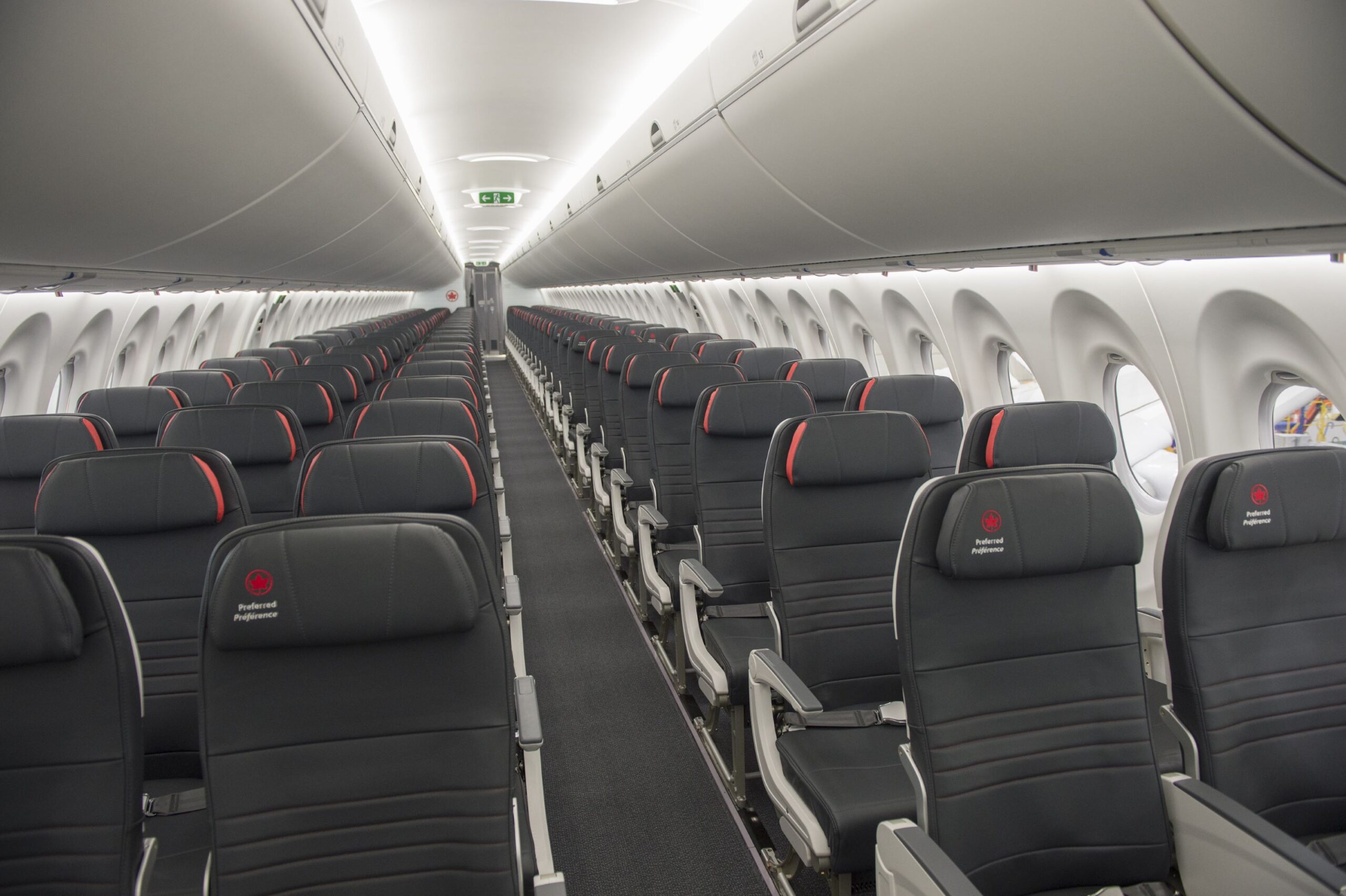
Economy is the standard cabin most travellers know: the cheapest seats, the most passengers, and the fewest perks. On AC’s international routes, which are often operated by Boeing 787, Economy is arranged in a dense 3-4-3 configuration with more than 200 seats. Meals are simple, the cabin is packed, and the service is basic. The biggest drawback for me is the seat itself: limited space, minimal padding, and an overall lack of comfort.
Air Canada Economy DUB – YYZ
Premium Economy Overview
Premium Economy (PE) sits between Economy and Business Class and is offered by many international carriers on long-haul routes. The cabin is much smaller, typically three rows in a 2-3-2 layout. Meals are slightly elevated, you receive a basic amenities kit, and the seats are bigger. After my first PE upgraded flight from Montreal to Frankfurt, it opened my eyes to a whole new world, as the seats and the cabin were dramatically more comfortable than Economy.
A Breakdown of the Differences
Seats & Cabin
On AC, the seats are the biggest upgrade in PE, and in my opinion, the only meaningful difference between the two cabins. PE seats recline up to 7 inches and are noticeably wider than those in Economy, with 18-20 inches between armrests (depending on the aircraft) and 38 inches of seat pitch. It’s a substantial increase in space that changes the experience.

Air Canada Premium Economy YVR – KIX
The cabin itself is much smaller, with just 21 seats, which makes it significantly quieter and more private, two things I really value. I’m someone who struggles to sleep on planes, so this alone is a major perk. In Economy, I have a 0% chance of sleeping, but in PE, I can usually manage an hour or so.
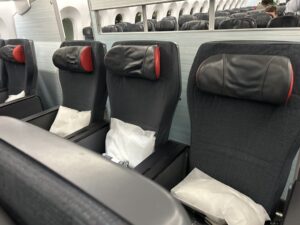
Air Canada Premium Economy DXB – YYZ
Baggage
AC PE includes two checked bags. Economy baggage allowances vary by fare class, but even the lowest Economy Standard fare includes one checked bag. Since many Economy fares also include two bags, this benefit isn’t a compelling reason to upgrade.
Meals & Service
The food on AC PE is barely an upgrade. The first meal is essentially the same as Economy, the only difference being that it’s served on real dishware instead of plastic trays. After that, all snacks and meals are identical to Economy and revert to disposable packaging. I’ve always enjoyed the first meal, but everything served afterwards tends to be bland and unappealing.
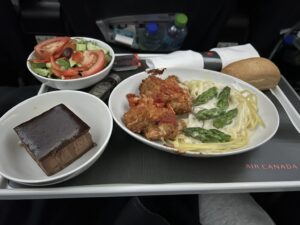
Air Canada Premium Economy Meal 1
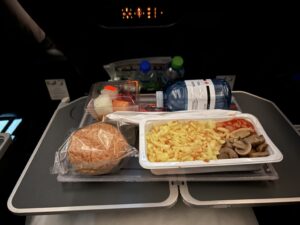
Air Canada Premium Economy Meal 2
The service in both cabins is more or less the same.
Cost & Points Earnings
During the peak winter season, the lowest AC Economy fare for YYZ – DXB is around $1,536. You’d earn SQC and Aeroplan points based on the amount you spend and the fare class (starting in January 2026). In the same period, PE ranges from $2,106 to $2,551, depending on the fare class. That’s a price jump of $570 or more for only fairly modest upgrades. Personally, I wouldn’t pay that big a difference. I’d book Economy and use eUpgrade credits to try for an upgrade instead, if eligible. It’s a risk, but I would take it.
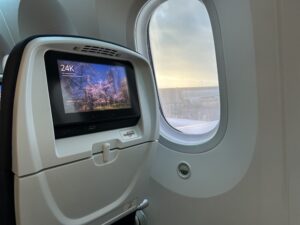
Air Canada Economy DUB – YYZ
During non-peak periods (June to September), the lowest Economy fare for the same flight is priced around $1,454, and PE is $1,776, which is a difference of about $322. The same SQC principles apply. At that smaller price gap, I would seriously consider booking PE for the added comfort. But I wouldn’t pay anything beyond that price difference. I’d get more value putting that money toward something relaxing once I land; while PE is definitely more comfortable than Economy, it’s still not that comfortable.
Airline Comparison: Emirates
I haven’t flown PE on other airlines yet, but Emirates PE is at the very top of my list. Their PE product is widely regarded as far more luxurious than AC’s.
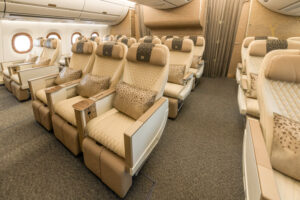
Emirates A350 Premium Economy (source: Emirates)
At DXB, Emirates has a designated PE check-in area, along with increased hand luggage allowance and free seat selection. Once onboard, PE passengers are greeted with a welcome drink and are offered a selection of wines not available in Economy.
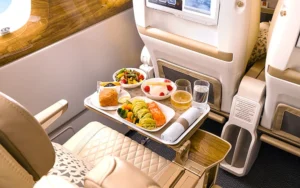
Emirates Premium Economy Meal (source: Emirates)
The cabin is designed for noticeably more comfort: soft leather seats, significantly more space, and elevated leg rests with cushioned support that allow you to actually put your feet up. Meals are also upgraded, with more generous portions and better presentation.
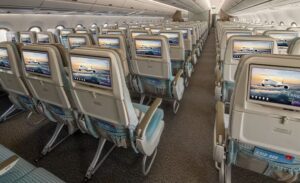
Emirates Economy Cabin (source: Emirates)
In terms of cost, something I’ve noticed is that fares on certain routes like DXB – JFK don’t fluctuate much throughout the year unless you’re booking last-minute. Economy typically sits around 3,500 AED, while PE is about 6,070 AED. That’s a difference of 2,570 AED (roughly $970 CAD). As much as I’d love to experience Emirates PE, paying nearly an extra $1,000 in cash is hard to justify when I think about what that money could get me instead: better hotels, excursions, activities, etc. That said, because Emirates offers a noticeably more luxurious product, I’d still be more willing to pay a higher premium for their PE cabin than I ever would for AC’s.
When Premium Economy is Worth It
For flights under five hours, Economy is perfectly fine for me. It’s not my favourite, but the marginal upgrades simply aren’t worth the extra cost on such a short trip. For long-haul flights, though, I’ll consider PE depending on the price difference. Sometimes I prefer to roll the dice and hope for an upgrade rather than pay outright. For example, this summer I flew from Vancouver to Osaka with AC using an Aeroplan redemption of 124,300 points for a multi-city itinerary. I could have redeemed an additional 34,000 points to book PE outright on the YVR – KIX leg, but instead I decided to save the points and take the risk. I used 14 eUpgrade credits and paid $300 for a successful bid to upgrade into PE, and from a comfort standpoint, it was absolutely worth it.

1 comment
WS PY is actually quite good. More enhancement vs Y when compared to the delta in AC