
Table of Contents
Points Miles and Bling (blog) contains referral or affiliate links. The blog receives a small commission at no additional cost to you. Thank you for your continued support. Credit Card issuers are not responsible for maintaining or monitoring the accuracy of information on this website. For full details, current product information, and Terms and Conditions, click the link included.
In today’s world, you need to use every trick and tool to secure high-value, saver-level award space when flying across the globe. In a previous post, I wrote about using co-terminal airports to your advantage, and today, we’ll discuss married segment logic as another trick to keep in your back pocket.
All About Married Segment Logic
When searching for awards, you might see some award flights that only exist when attached to another flight. It can be confusing, to say the least, but this logic comes from traditional airline inventory and revenue management systems.
Usually, this appears as a long-haul direct flight not being available unless there’s a connecting flight attached. As an example, you can see that Boston – Zurich is available in business class on Lufthansa with a layover in Munich.
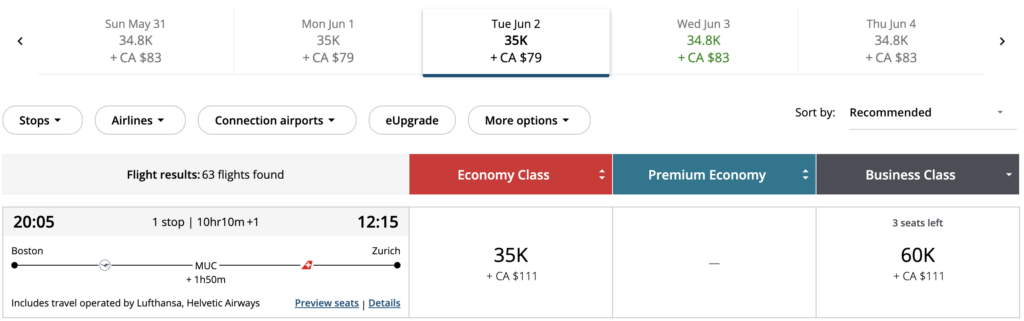
Boston – Munich – Zurich all in business class
Meanwhile, the direct flight from Boston to Munich is not available in business class to book on its own.
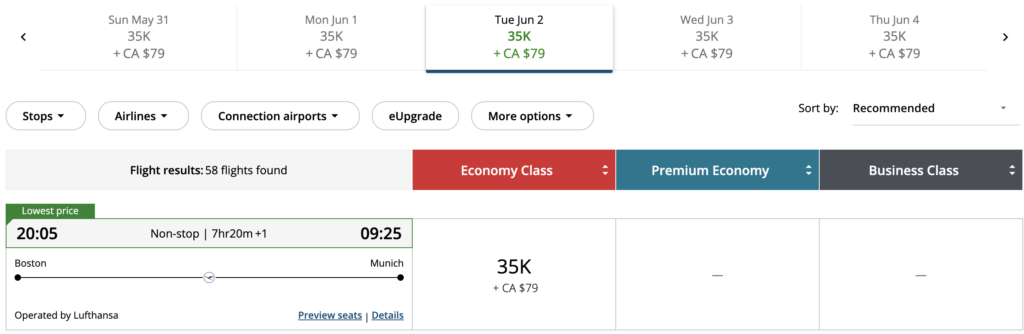
Boston – Munich is not available in business class
The only way to book a business class seat on that direct Lufthansa flight from Boston to Munich is to tag on another flight to Zurich (or possibly other cities). With Aeroplan, the implications are obvious – if adding on a flight pushes the itinerary into the next distance band, you are on the hook to pay the higher price in points. In this case, Zurich is still close enough to stay in the 60,000-point band.
Why Does Married Segment Logic Exist?
In short: to maximize profits. Married segment logic award applies to both cash and award bookings, with the former often seeing direct flights priced higher than the same flight with a connection.
People are willing to pay a premium for direct flights, and airlines know this, too. If you’re trying to fly from Boston to Zurich, you would choose the direct SWISS flight over a connecting option via Munich.
The operating airline controls married segment logic, not the ticketing airline. In this case, Lufthansa, not Aeroplan, is “to blame”.
Can I Split Up a Married Segment?
The short answer is no, and the long answer is also no. Airline systems are advanced enough to block these attempts, no matter how you try to structure them.
For example, if you book Boston–Munich–Zurich and call Aeroplan to remove the Munich–Zurich segment, the system won’t allow it. Even though Aeroplan supports custom itineraries, the agent can’t remove the second leg because the system treats both flights as a single, uneditable itinerary.
Using Married Segment Logic to Your Advantage
There’s no straightforward way to leverage married segment logic, since it doesn’t let you create new award availability. I’d compare it to co-terminal airports, where knowing about it gives you an advantage compared to those who don’t.
Many people, including myself, often search for award space segment by segment, first looking for the longest leg crossing the ocean. Married segment logic is an issue with this approach, as the long-haul flight will be the one not available on its own.
One of the easiest ways to search around married segment logic is with seats.aero. In the Explore function, clicking on business class will first show only direct flights that are available (in green). If you scroll down or visit the next few pages, the blue options are ones with connecting flights, often with married segment logic tied in.

seats.aero searching Aeroplan
With programs like American Airlines AAdvantage and Cathay Pacific Asia Miles, searching for flights with an additional connection can either drop the price or open up new availability due to married segment logic. You will have to search city by city and/or date by date. After being more familiar with various frequent flyer programs, you’ll get a feel for which airlines have a lot of married segments and which cities can open up more space or drop the price.
If the segments are married and you don’t want to fly to the final destination, you can stay in the connecting airport and intentionally skip the final leg (skiplagging). Note this comes with its own risks, so you’ll have to decide if it’s worth it.
Takeaway
Married segment logic is one of the more confusing aspects of award travel, but understanding how it works can help explain why certain flights only appear with connections attached. While it doesn’t create new award space, knowing about it gives you another tool to work around limited availability and uncover flights you may otherwise miss.
