
Points Miles and Bling (blog) contains referral or affiliate links. The blog receives a small commission at no additional cost to you. Thank you for your continued support. Credit Card issuers are not responsible for maintaining or monitoring the accuracy of information on this website. For full details, current product information, and Terms and Conditions, click the link included.
The new Amex Hilton card launched with much fanfare, and applications are no doubt rolling in. With a Free Night Reward on offer, everyone I know is looking to sign up. Except it seems a lot of people are running into rejections or pending applications, and Amex’s four credit card limit appears to be the culprit. The emphasis is on credit cards because you can have unlimited charge cards.
Amex has had this rule for a while, but cardholders who exceeded the limit years ago have been allowed to keep their existing cards. Amex grandfathered in existing cardholders, but the four-card limit still applies to new applications, and it seems Amex is now counting business cards towards that limit as well.
With the new Amex Hilton card competing for a spot in your four credit card wallet, let’s consider which credit cards are worth holding onto.
Amex Charge vs. Credit Cards
It’s a confusing subject because American Express is the only issuer in Canada to issue charge cards.
Essentially, charge cards don’t have a predetermined credit limit. Instead, your spending capacity adjusts based on factors like your account history and spending patterns. Credit cards, on the other hand, have a fixed credit limit and allow you to carry a balance subject to interest.
In practice, though, the distinction isn’t quite so clear. Amex offers a Flexible Payment Option that lets you carry a balance with interest, much like a regular credit card. Amex also determines how much you can carry over and sets an internal spending limit based on your account history and spending patterns. So while charge cards technically have no preset spending limit, that doesn’t mean you can spend unlimited amounts of money.
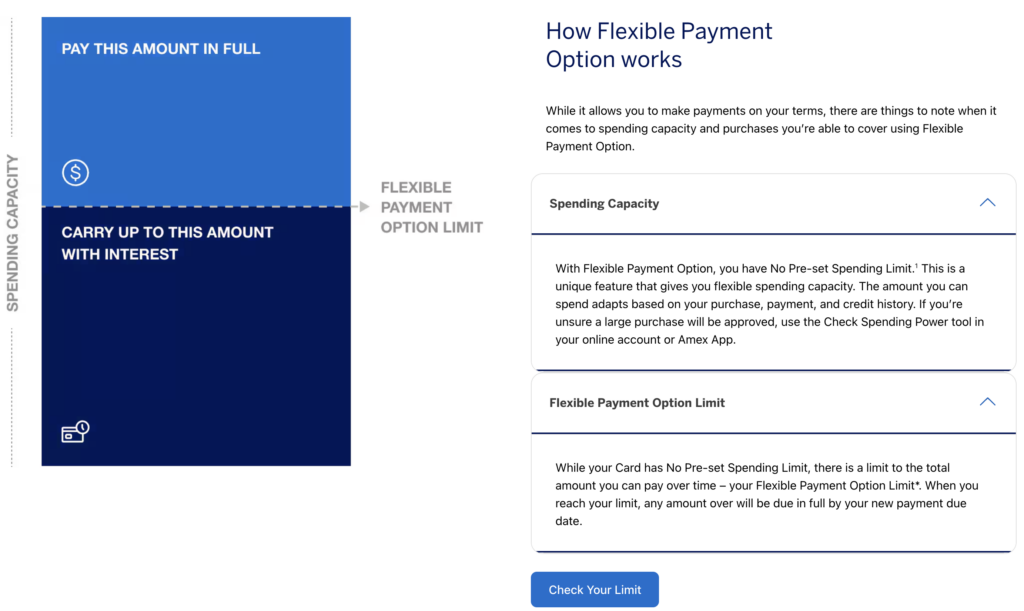
On charge cards, Amex offers Flexible Payment Option
One of the main reasons we care about the distinction between charge cards and credit cards is that Amex only allows you to hold four of the latter.
As for which card is which, see the following chart.
| Card type | Cards |
|---|---|
| Charge cards | The Platinum Card American Express Aeroplan Card Business Platinum Card from American Express American Express Business Gold Rewards Card |
| Credit cards | American Express Gold Rewards Card American Express Aeroplan Reserve Card American Express Aeroplan Business Reserve Card American Express Cobalt Card Marriott Bonvoy American Express Card Marriott Bonvoy Business American Express Card American Express Green Card SimplyCash Card from American Express SimplyCash Preferred Card from American Express Hilton Honors American Express Card |
Which Four Credit Cards?
Normally, this is the part where a blogger tells you, “well, it depends on your own life circumstances and travel needs,” which is true to an extent. But for the short period between now and the end of 2026, I have three cards in mind that I think “most” people should get.
Card 1: Amex Cobalt
In my opinion, this is the best Amex card in Canada, and you will be shocked at how quickly your Amex MR balance grows if you use it for groceries, dining (5X), gas/transit/rideshare (2X), and streaming services (3X).
The monthly fee of $15.99 (or an annual fee of $191.88 in Quebec) easily pays for itself if you spend most of your time in Canada and frequently shop at grocery stores and visit restaurants. Transfer your MR to Aeroplan, Avios, Flying Blue, and more, and it becomes clear this is the best card for racking up points to redeem for premium cabin travel.
If I could only have one Amex card (much less choose only among credit cards), it would be this one.
Cards 2 & 3: Amex Marriott Bonvoy & Bonvoy Business
Before the $3,000 annual spending requirement for the 35,000-point Free Night Award came into play, these two cards easily took slots 2 and 3. Pay your $120 annual fee (going up to $150 on February 9 for personal Bonvoy; the $150 fee stays the same on Bonvoy Business) and get a Free Night Award that you can top up with 25,000 more Marriott Bonvoy points, and I’d say these two are definitely keepers.
Admittedly, the $3,000 annual spending requirement removes both cards from “automatic keeper” status, but for the next month and a half until the end of 2026, I’d say both cards are worth signing up for. If you already have the card or sign up before the end of the year, your 2027 Free Night Award will have no spending requirement. You’ll then need to meet the $3,000 spending requirement to earn the FNA at your 2028 anniversary.
Holding both takes up half of your four available slots, though, so whether you keep both depends on how much you value the cards below.
Card 4: Amex Hilton, Aeroplan Reserve
Here’s where things get a little dicey. The Amex Hilton card is brand new, and whether it’s a keeper remains to be seen, but the welcome bonus is fantastic and absolutely worth signing up for.
You get 60,000 Hilton points and a Free Night Reward upon spending $3,000 in the first three months, and another 10,000 points if you spend $500 in month 13. Ongoing perks include earning 50,000 bonus Hilton points for spending $12,000 a year, or moving from complimentary Hilton Gold to Hilton Diamond status by spending $40,000 a year.
On the other hand, the Amex Aeroplan Reserve is a must if you’re heavily entrenched in the Aeroplan Elite status ecosystem and want to earn 25,000 SQC by spending $125,000 a year. Even if you’re not chasing status, holding the card gets you Zone 2 boarding, priority check-in and baggage handling, priority security, and (soon) unlimited access to Maple Leaf Lounge and Air Canada Cafe worldwide.
The thing is, you can get a TD Aeroplan Visa Infinite Privilege or CIBC Aeroplan Visa Infinite Privilege to achieve the same perks and free up an Amex slot.
Come January 12, though, the gap between the Amex Aeroplan Reserve and the TD and CIBC cards grows thanks to a slew of Aeroplan card changes. The Amex Aeroplan Reserve’s value proposition will arguably be better despite the higher annual fee, thanks to the $200 dining credit and six Priority Pass and eight Amex Aspire lounge visits. Additionally, TD and CIBC’s $150,000 income requirement is a higher barrier to entry.
If you don’t need a premium Aeroplan card, the $120 annual fee Amex Aeroplan Card comes with a free checked bag, is a charge card, and doesn’t use up a slot.
Takeaway
Amex’s four credit card limit is becoming a real consideration with the launch of the Hilton card, especially now that business cards appear to count towards the limit. Personally, I’d prioritize the Cobalt and both Marriott Bonvoy cards for now, particularly while new applicants can still secure a Free Night Award without the upcoming spending requirement.
The fourth slot is where I’d be more selective. The Hilton card’s welcome bonus is hard to ignore, but the Aeroplan Reserve offers compelling ongoing benefits for frequent Air Canada flyers. And if you want both, you’ll probably have to give up one of the Marriott cards.
If you’re a two-person household, though, you have more flexibility to mix and match cards. You don’t necessarily need two Cobalt cards if you’re not hitting the $2,500 monthly cap on 5X spending, and couples who mostly travel together probably only need one premium Aeroplan card between them.
Featured Image Credit: American Express Canada
