
Table of Contents
Points Miles and Bling (blog) contains referral or affiliate links. The blog receives a small commission at no additional cost to you. Thank you for your continued support. Credit Card issuers are not responsible for maintaining or monitoring the accuracy of information on this website. For full details, current product information, and Terms and Conditions, click the link included.
Hidden city ticketing, or skiplagging, is the practice of booking a ticket to one destination and getting off at a connecting stop before you reach your final destination. Airline pricing is a convoluted subject, but the simple reason behind hidden-city ticketing is that airlines know customers will pay more for a nonstop flight.
Of course, this practice is not without risk, as airlines strongly prefer that you don’t book flights you don’t intend to take. However, I recently ran into an interesting married-segment situation where skipping a flight might actually make the most sense.
The Basics of Hidden City Ticketing
Let’s first go over the basics. Say a ticket from Toronto to Montreal is $235, and a ticket from Toronto to Quebec City via Montreal is $180. The numbers are made up, but that’s the gist of how it works. In this scenario, you would book the ticket to Quebec City and hop off in Montreal, saving yourself $55.
The same phenomenon applies to award tickets. With Aeroplan’s dynamic pricing, a direct flight can sometimes be more expensive than adding another leg. For example, flying from Mumbai to Toronto costs 248,100 Aeroplan points in business class.
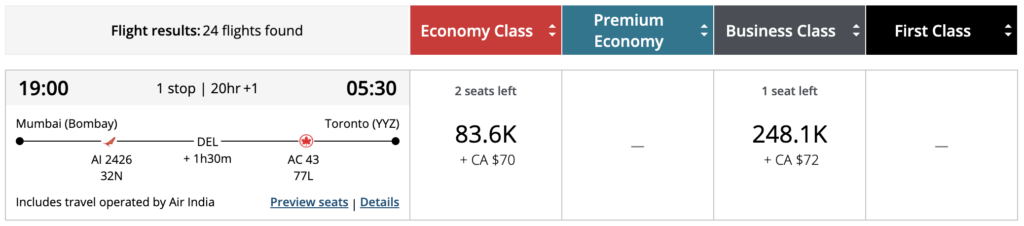
248,000 points for Mumbai – Toronto
However, adding a leg to Ottawa actually drops the price to 235,000 points. Notice it’s the exact same long-haul flight, AC43, from Delhi to Toronto.
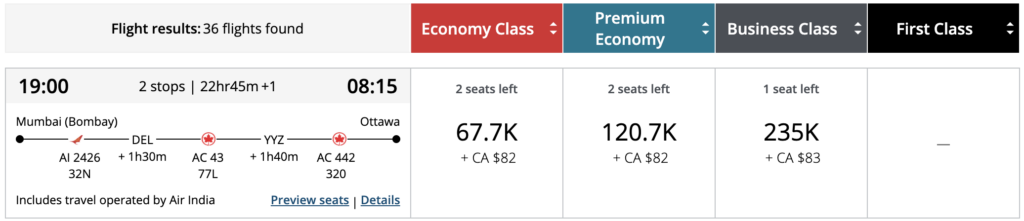
235,000 points for Mumbai – Ottawa
The above was a simple example, but I know most of you are not looking to pay 200k+ points for a one-way business class flight. Nevertheless, consider broadening your search for future trips to include nearby destination airports. You’ll be surprised to see how much the price fluctuates.
Married Segments and Skiplagging
Last time we discussed married segments, the focus was on using it to locate more award space. But did you know flights can end up married even if both segments were originally available to book separately?
Here’s my situation: I located Turkish Airlines business class award space from Boston to Istanbul, then separately found space for Istanbul–Bishkek. I booked this as a single one-way itinerary for 90,000 points.
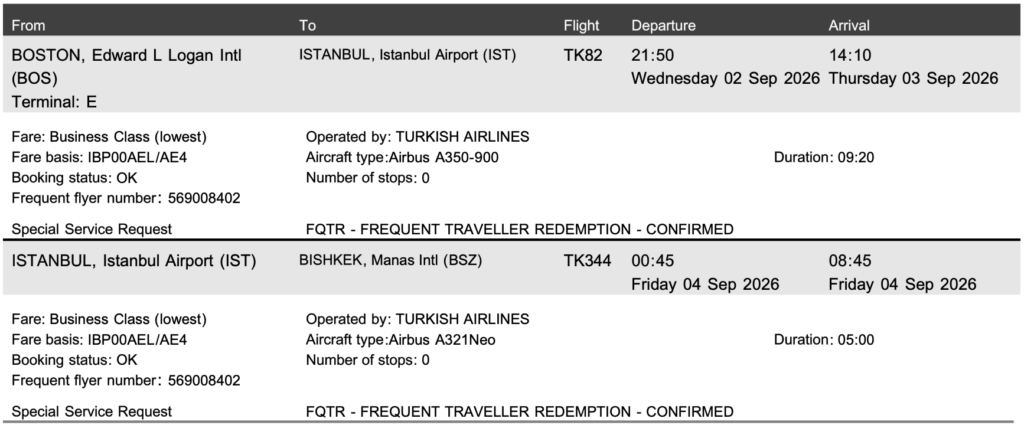
Boston–Istanbul–Bishkek costs 90,000 Aeroplan points one-way in business class
9 months later, I want to actually have a stopover in Istanbul and fly to Bishkek a few days later. This is usually straightforward: pay 5,000 points for a stopover, pay a $100 change fee, and change the second leg to a few days later.
Turns out it was not. After a few phone calls with Aeroplan, it became clear that Turkish Airlines had married the two segments. Although each flight originally had standalone award availability, I could no longer remove one segment without removing the other.
Two agents understood the predicament and actually suggested missing my original flight and booking the new Istanbul–Bishkek flight separately.
In this case, there is no way for me to legitimately change my ticket to terminate in Istanbul without cancelling the entire award. I’m not willing to take that risk if the Boston–Istanbul award space doesn’t return, so I’m in a bit of a pickle.
The Risks of Hidden City Ticketing
Hidden city ticketing is not something everyone will be comfortable with, as there are definite risks to be aware of.
The first risk arises during irregular operations (IRROPS). In those situations, the airline’s obligation is to get you from your origin to your destination—not necessarily through the same connecting city. The airline could rebook you onto a direct flight or route you through a different hub altogether, eliminating the opportunity to exit where you originally planned.
The second issue is checked baggage. In most cases, airlines tag checked bags to the final destination, making hidden city ticketing impractical unless you travel with carry-on luggage only.
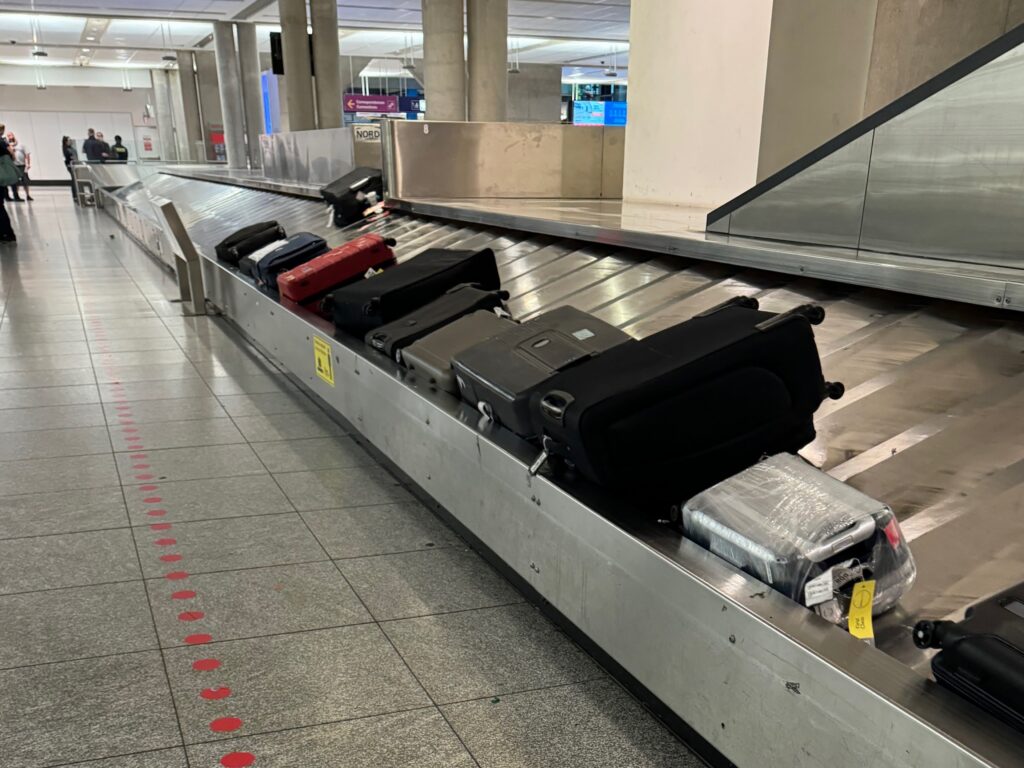
Don’t check bags if you’re skiplagging
You can reduce both risks to some extent. If your airline routes all flights to your destination through a single hub, you’ll likely still connect there during IRROPS. You can also ask agents to place you on specific flights when they rebook your itinerary. As for baggage, travelling with carry-on luggage avoids the issue entirely. There are also exceptions, such as entering Canada, where you must collect your bag at your first port of entry.
The biggest risk is the airline itself. If caught, airlines may suspend your frequent flyer account, reprice your ticket, or even ban you from future travel. Some travellers attempt to reduce scrutiny by calling the airline after landing in the connecting city and asking to be offloaded.
Personally, I view the risk as relatively low when done occasionally. There’s a big difference between missing a connecting flight once a year and repeatedly skiplagging the same route. After all, passengers miss flights for legitimate reasons all the time. Surely you’ve headed into the city on a layover and didn’t quite make it back on time. 😉
Takeaway
Hidden city ticketing isn’t something I’d recommend blindly, and it’s certainly not for everyone. Some travellers won’t be comfortable with the risks, while others may decide the savings or convenience justify them. Ultimately, it comes down to your own risk tolerance.
In my particular case, I’m still deciding on the best course of action regarding my Turkish Airlines ticket to Bishkek. If I want to end that leg of my trip in Istanbul, skiplagging is the only option. For now, I’m hoping Turkish Airlines opens up more availability so I can change my entire ticket altogether without issues.
Featured Image Credit: Turkish Airlines
