Table of Contents
Points Miles and Bling (blog) contains referral or affiliate links. The blog receives a small commission at no additional cost to you. Thank you for your continued support. Credit Card issuers are not responsible for maintaining or monitoring the accuracy of information on this website. For full details, current product information, and Terms and Conditions, click the link included.
I had given myself more than 5 hours in Toronto between our positioning flight from Ottawa and our Virgin Atlantic flight to London, which should have been more than enough time to deal with the usual separate-ticket risks I’m always warning people about. And in one sense, it was: we made it to Toronto with plenty of time to catch our next flight. The problem was that our bag missed the flight and never left Ottawa.
What followed was a scramble I had almost no data points on: what actually happens when a checked bag misses a leg that’s on a completely separate ticket, and you’re leaving the country that same night on a different airline?
The short version: it worked out far better than I expected. The long version is why.
The Trip and How I Booked It
This was our summer trip to Scotland and Iceland, starting with a positioning flight from Ottawa to Toronto, followed by a little over 5 hours of buffer before our Virgin Atlantic flight to London. Between the three of us, we had one shared checked bag containing most of our outdoor gear, which we would need later in Iceland.
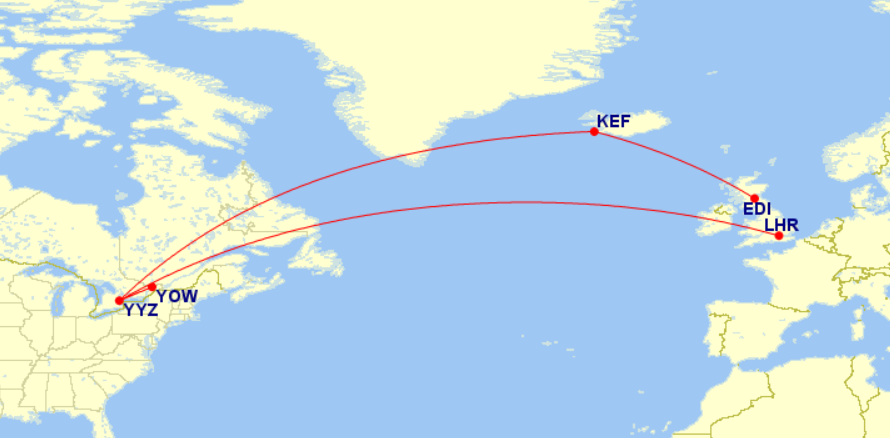
Trip Routing
For those interested in the points-and-miles side of the trip, the flights were booked as follows:
- Ottawa–Toronto: Porter Reserve — 6,000 Atmos points + $36
- Toronto–London: Virgin Atlantic Premium Economy — 16,500 points + $188
- London–Reykjavik: Icelandair Economy — 10,600 JetBlue TrueBlue points + $139
- Reykjavik–Toronto: Icelandair Business — 56,000 Amex Membership Rewards points, booked as a cash ticket
Why I Have Rules About Positioning Flights
I’ve often mentioned the importance of giving yourself plenty of time between a positioning flight and your main flight, or even better, arriving the night before. The reason for this is obvious: a delay or cancellation of your first flight could cause you to miss that long-haul trip you’ve planned for months. When you’re booking separate tickets, airlines often see these as completely independent trips. So, if something goes awry on your initial flight, the second airline isn’t obligated to help you out just because you have another flight booked afterward.
What I hadn’t really considered before is that this same issue can happen with your checked luggage as well.
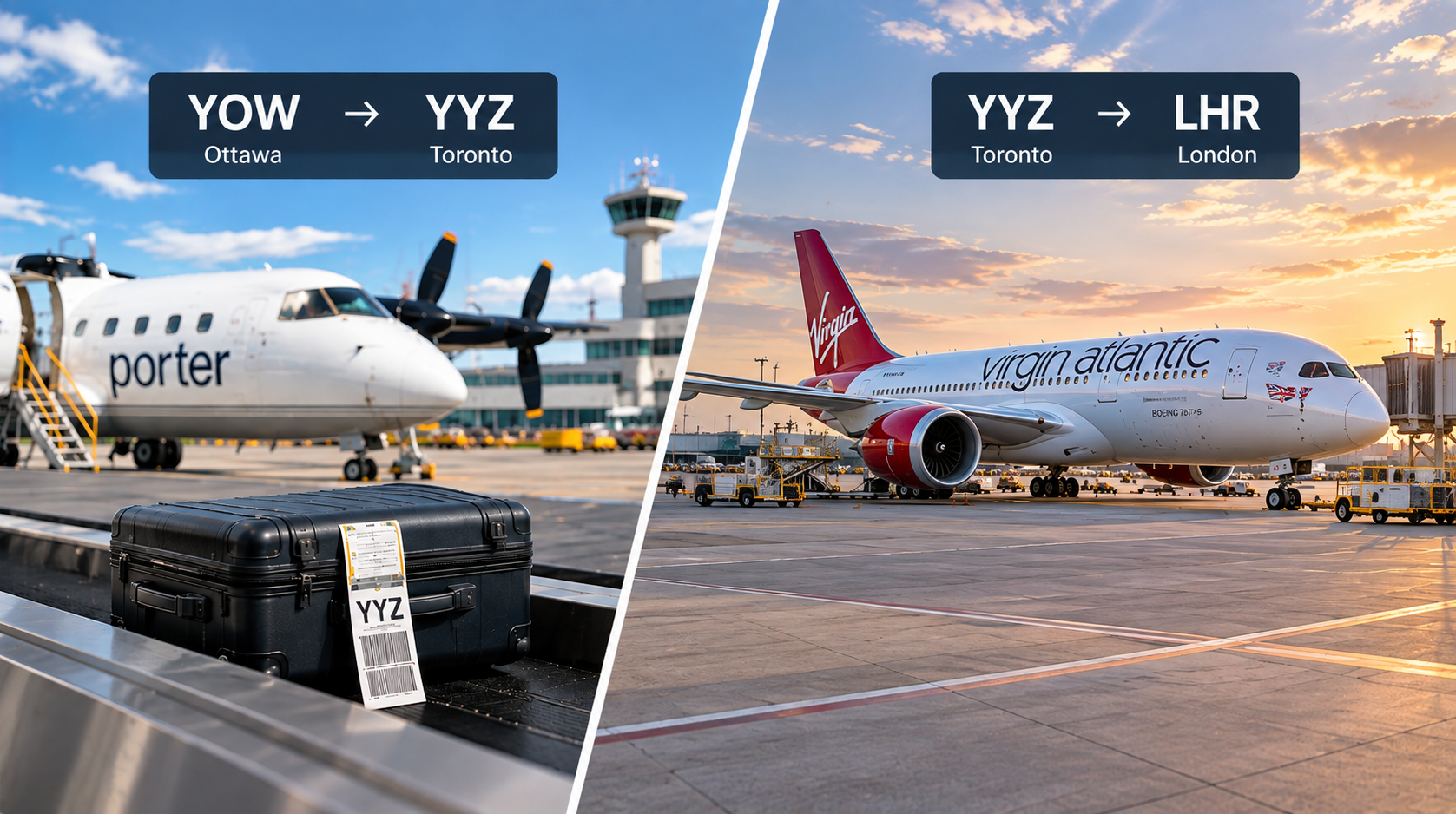
When you’re on separate tickets, your bag isn’t through-checked; it’s only tagged to your destination on that first ticket. Once it gets there, you’re supposed to pick it up and check it in again with the next airline. Usually, this isn’t a problem, but if your bag doesn’t arrive on that first flight, it’s no longer just a missed connection. It becomes a situation where you need to find a way to get your suitcase, in one city, onto a completely different airline after you’ve already left the country.
For me, travelling from Ottawa, this has never been an issue. It’s a small airport, Toronto is just a short flight away, and after hundreds of departures over the years, I can’t recall a checked bag ever not making it onto the plane. Plus, I had over 5 hours in Toronto, so I thought I had plenty of buffer time.
As it turns out, that was more than enough for us. But unfortunately, it wasn’t quite enough for the bag.
How I Lost a Bag on the Easiest Flight
The first warning came that morning when my Porter flight to Toronto was cancelled, and I’d been auto-rebooked onto a different flight number at the same time, with an equipment change from an E195 down to a Q400. Same departure, same arrival, still direct. I didn’t think much of it.
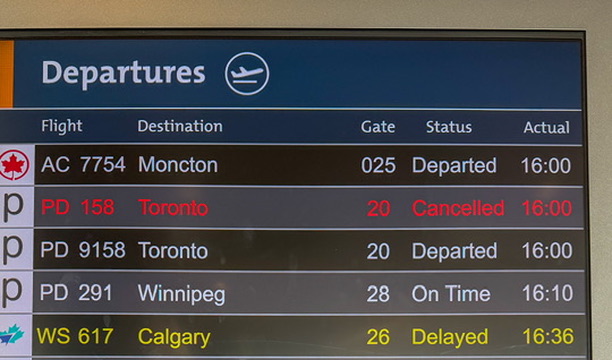
PD158 renamed to PD9158 due to equipment swap
What I found out later is that this wasn’t a routine schedule change. The original aircraft had been pulled from service for mechanical reasons, and Porter scheduled what they called a “rescue flight” using a Q400. That aircraft change would ultimately explain why my bag never got loaded.
Standing at check-in in Ottawa, I remember having a strange feeling that something was going to happen with the bag. There was no real reason for it, so I ignored it, handed over the suitcase and carried on through security. Our Porter flight ended up being more than an hour delayed, which was annoying but still left plenty of time in Toronto to connect. Once onboard, I opened Find My out of habit and checked the AirTag inside the suitcase. To my surprise, the bag appeared to still be sitting inside the Ottawa terminal!
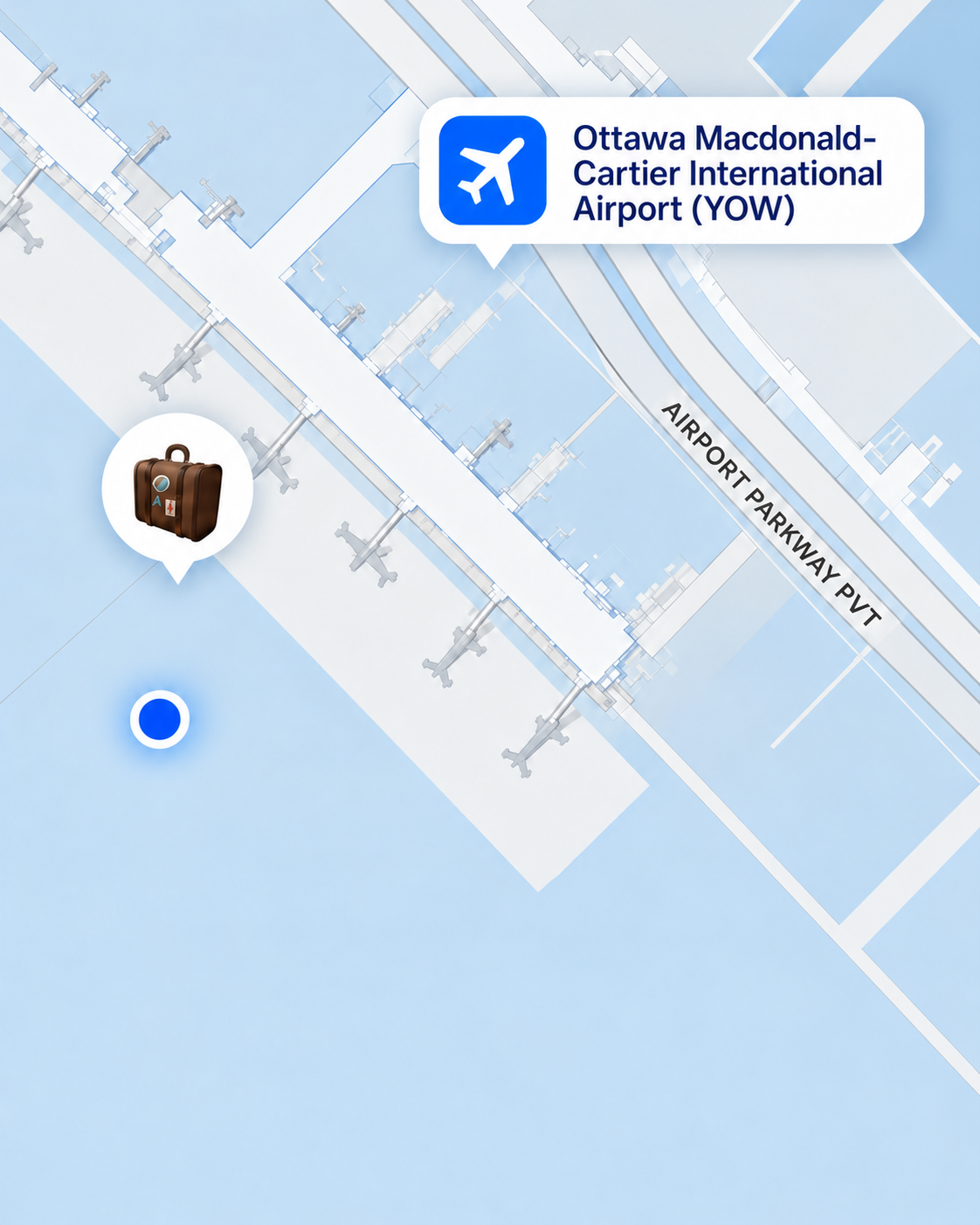
Boarded on the palne, bag still in the terminal
AirTags aren’t perfectly precise in an airport environment, so I mentioned it to a flight attendant while the doors were still open. She reassured me that the bag should be onboard, but a few minutes later the AirTag updated again and was still showing inside the terminal, nowhere close to our aircraft. At that point, I was pretty convinced the bag wasn’t coming with us.
There was nothing I could do anymore, so I spent much of the flight mentally going through what we had packed. Unfortunately, the suitcase contained exactly the sort of things we would need later in the trip, including rain jackets, extra layers for Iceland and hiking shoes.
When we arrived in Toronto, the Porter baggage agent confirmed what the AirTag had already told me. The suitcase had never been scanned onto the aircraft and was still sitting in Ottawa. The agent also explained what had happened: because the replacement Q400 was much smaller than the original E195, there simply wasn’t enough room for every suitcase, so connecting passengers’ bags were prioritized.
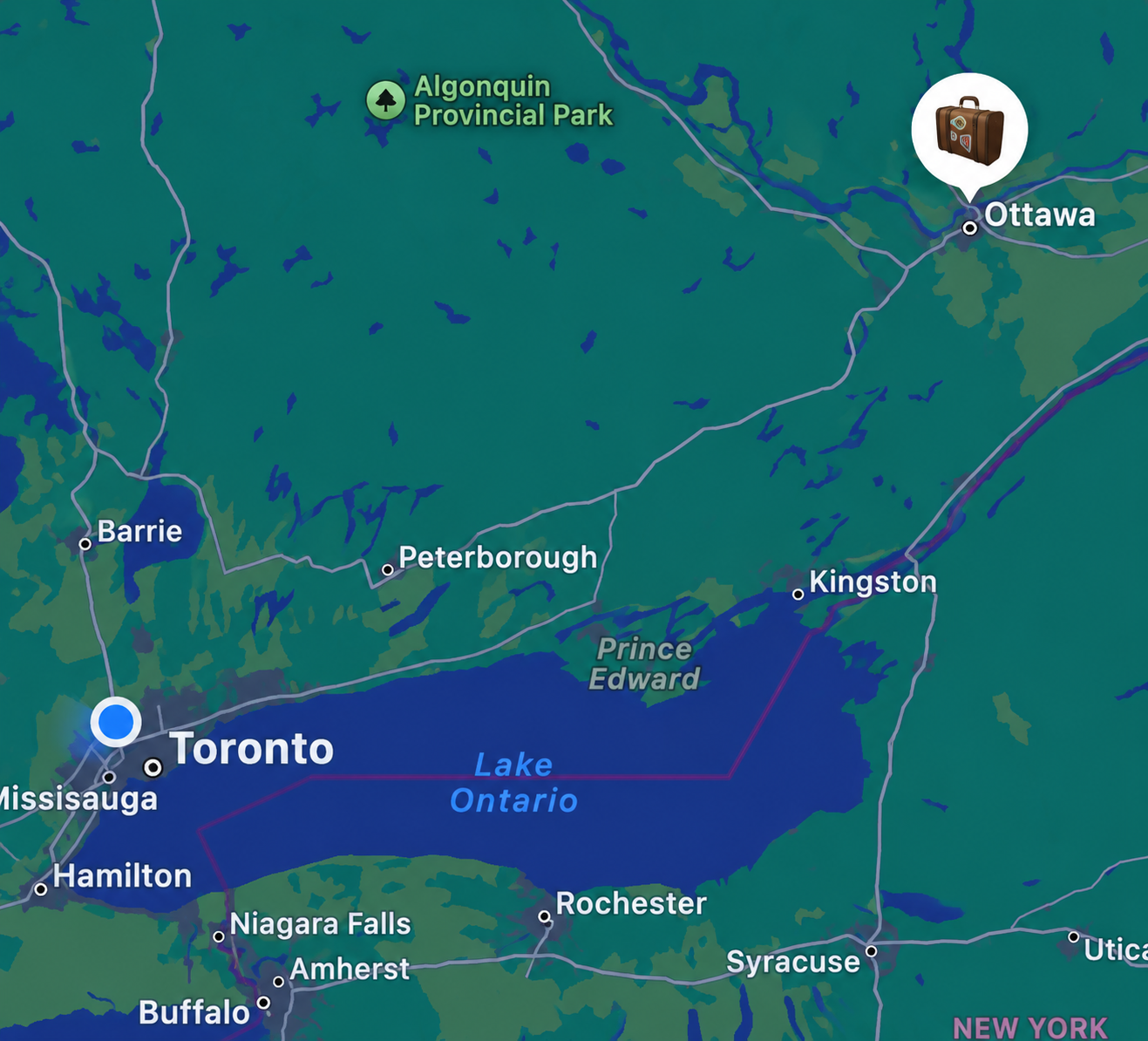
Bag left behind in Ottawa
Our bag was tagged only from Ottawa to Toronto, and nothing in Porter’s system knew that we had a completely separate Virgin Atlantic flight leaving for London later that evening. That made our suitcase one of the easiest bags to leave behind.
Getting a Bag Across the Atlantic on Two Separate Tickets
At this point, I assumed our bag would eventually make its way to Toronto and then either sit there until we returned or somehow get sent back to Ottawa. Neither option was very useful considering we were heading to Scotland and Iceland and needed our gear. Instead, the Porter agent told me something I wasn’t expecting: they could hand the bag over to Virgin Atlantic, and Virgin could forward it to us in the UK. Even though these were two completely separate tickets, and the bag had never been checked with Virgin, there was apparently a process to make it happen, as long as both airlines were willing to cooperate.
It starts with a Property Irregularity Report, or PIR, which is the official file created when a checked bag doesn’t arrive. Porter had already opened one for me in Toronto, and because only one PIR can be active for a bag at a time, Virgin couldn’t simply open another. We flew to London without the suitcase and, upon arrival at Heathrow, I went to the Virgin Atlantic baggage desk, where the agent added notes to the existing Porter file and told me to email Virgin’s baggage tracing department to initiate what they called a courtesy delayed baggage claim.
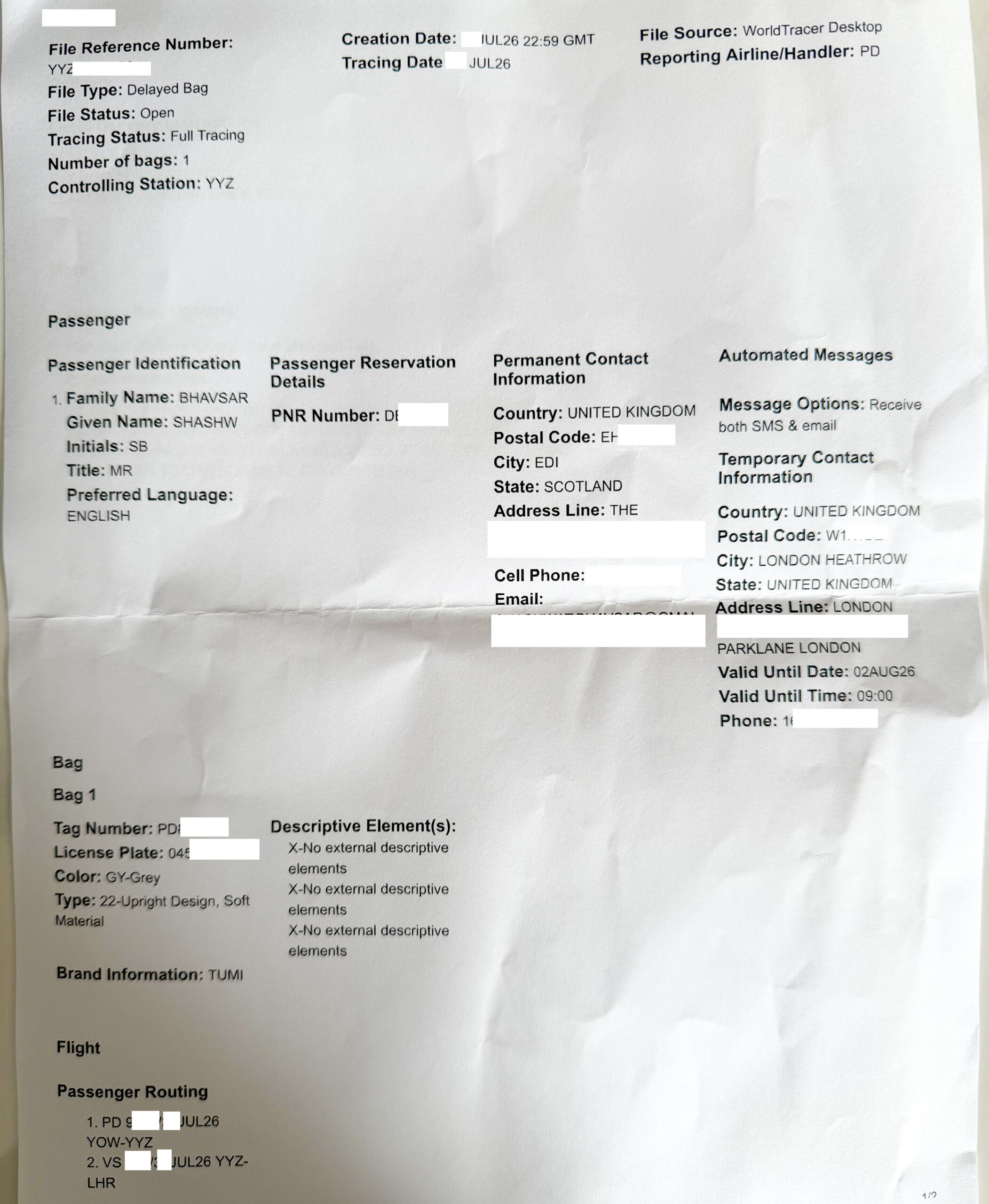
Property Irregularity Report created by Porter
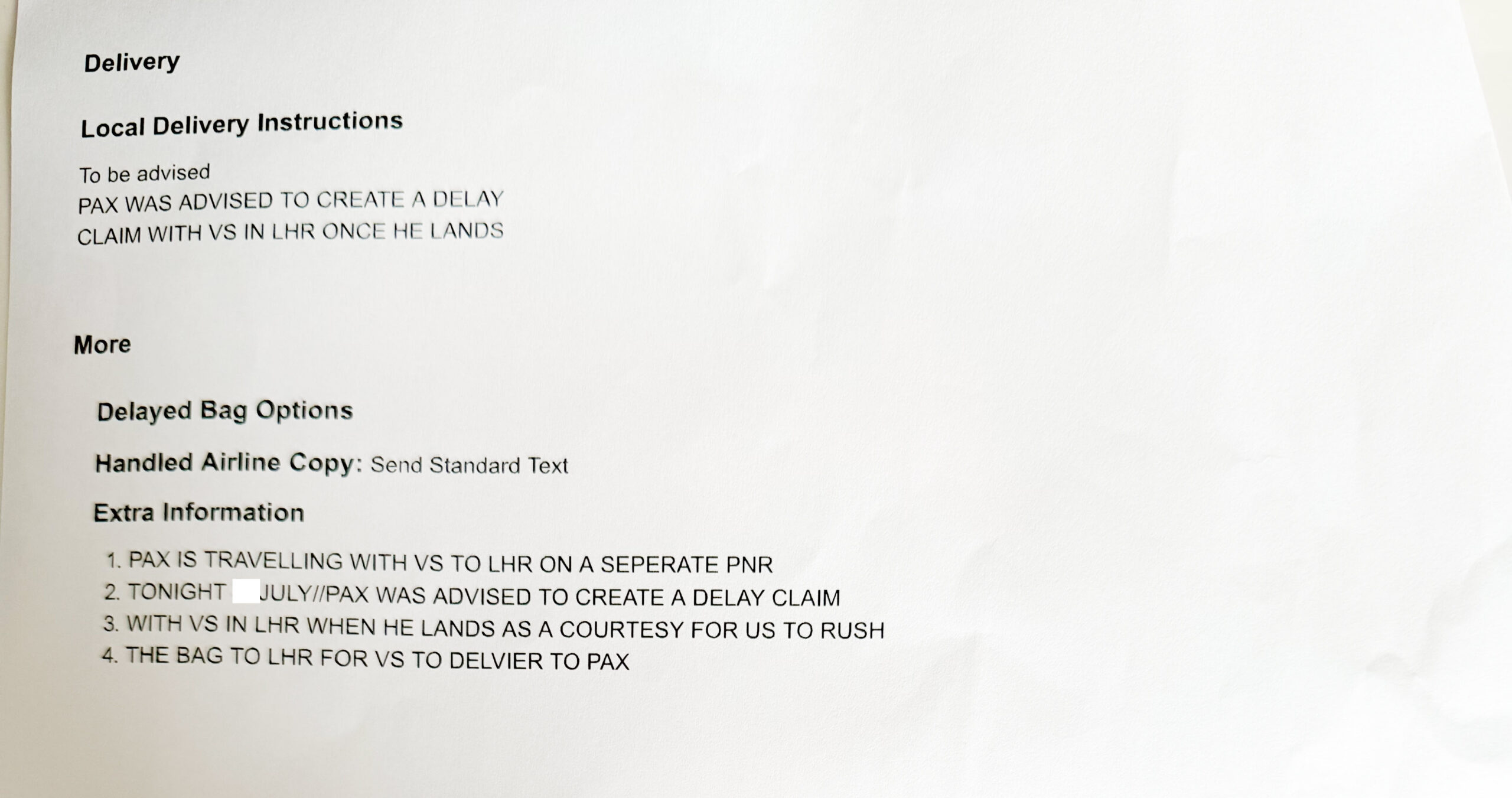
PIR with relevant notes provided
Virgin responded within about an hour, confirming they could take over the bag. A few hours later, Virgin opened a PIR on their side, and Porter closed theirs, meaning the suitcase could be handed over to Virgin in Toronto.
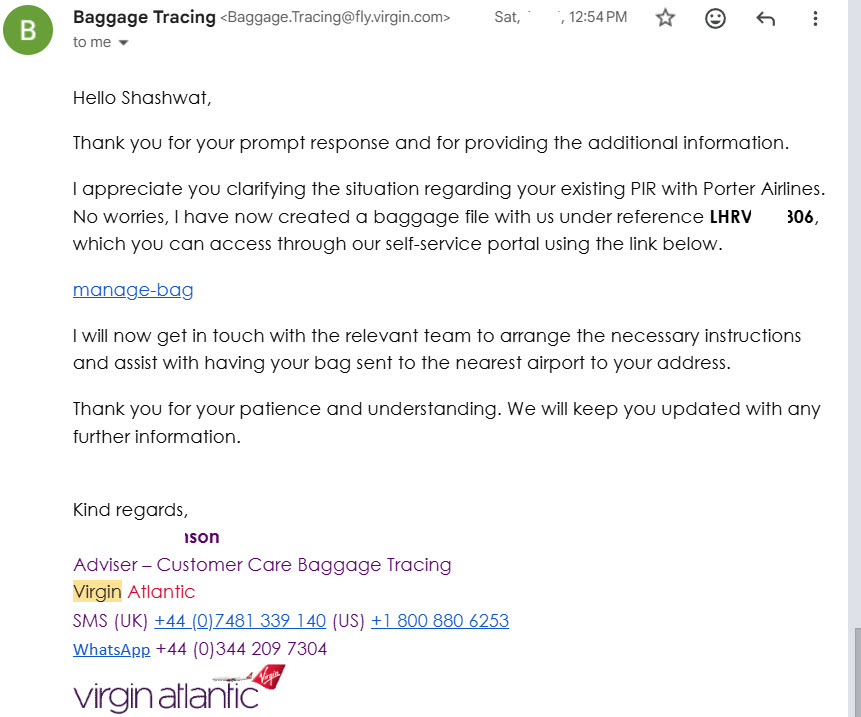
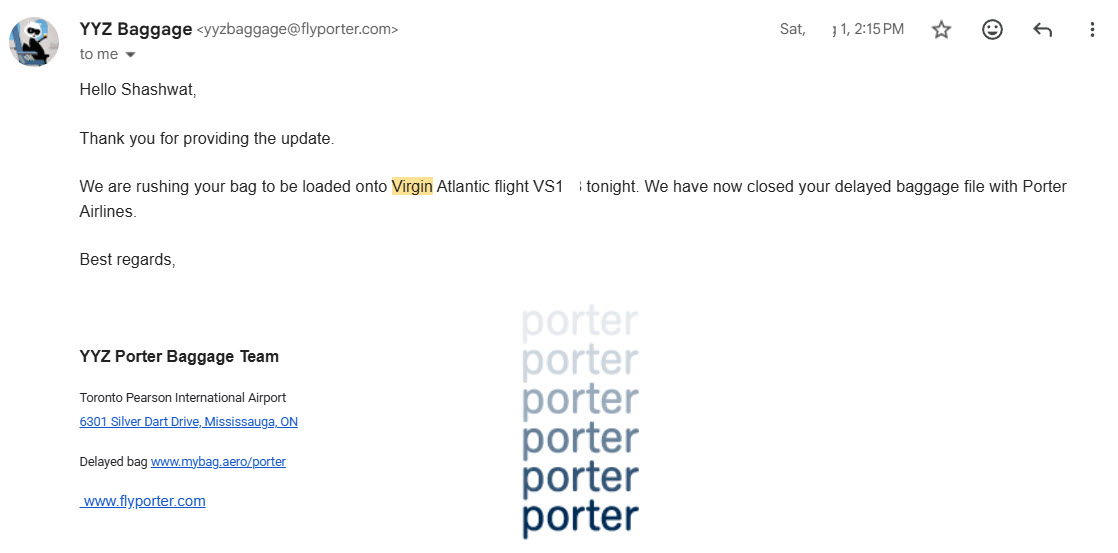
Not long afterward, Porter’s Toronto baggage tracing team emailed me confirming the bag would be on Virgin’s flight from Toronto to London that night.
Wow, I really did not expect this to work out so efficiently. Later that day, I checked the AirTag and, sure enough, the suitcase was sitting near the runway at Pearson, so I knew it had at least made it out to the aircraft.
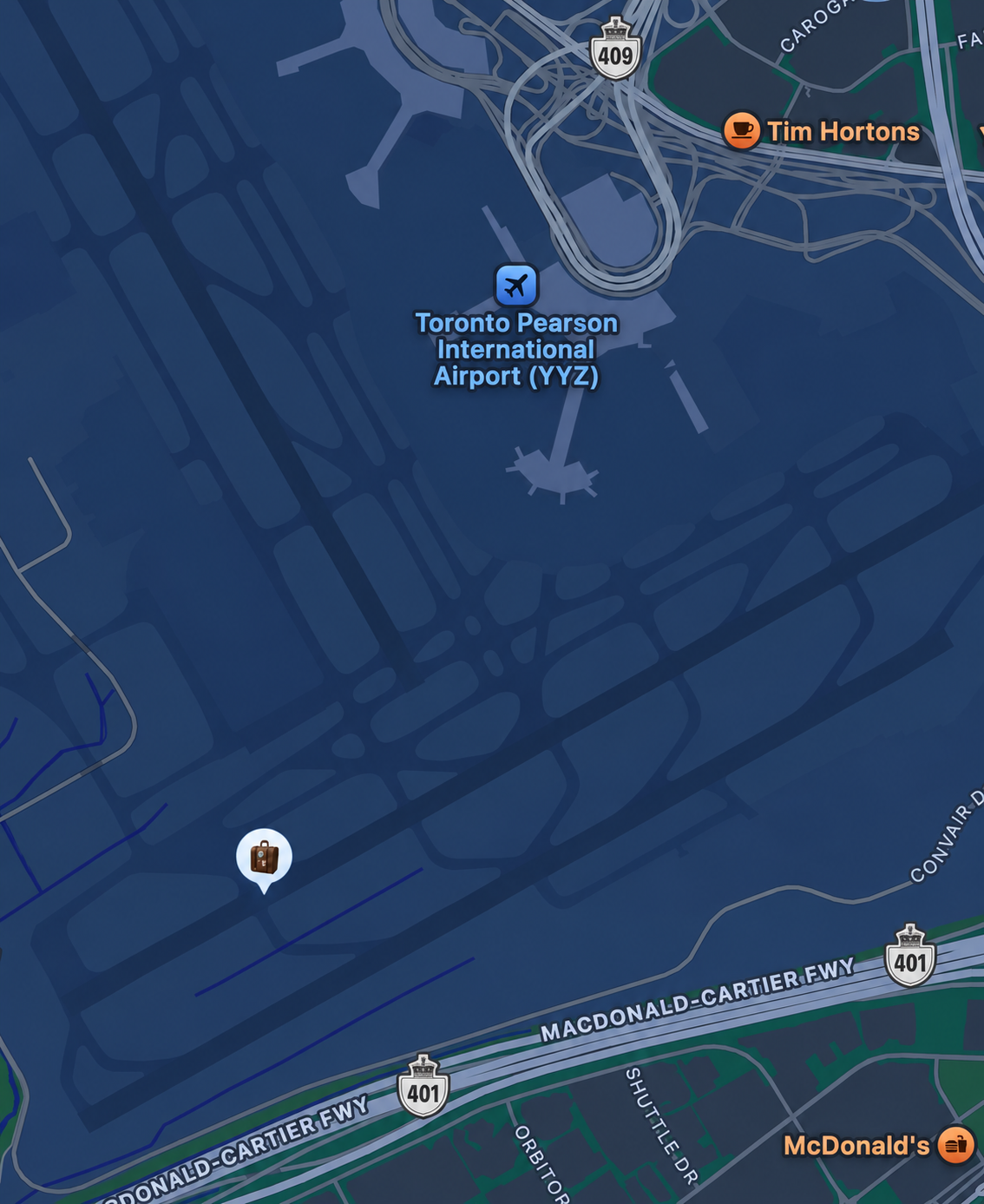
Last known position of the bag in Toronto
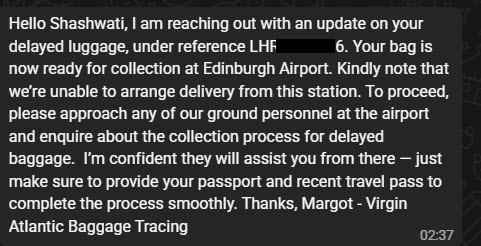
The next morning, I opened Find My again and saw that the bag had made it to Heathrow. The only problem was that we had already left London and continued to Edinburgh. Rather than call Virgin, I sent them a message over WhatsApp. They were extremely responsive and, about two hours later, confirmed they had the suitcase and would send it to Edinburgh that evening on a British Airways flight. The only thing Virgin couldn’t confirm was delivery to my hotel. Since the airport isn’t particularly far from the city, I told them I would just pick it up myself.
I went to Edinburgh Airport the following morning, and finding the bag was actually harder than I expected, which was somewhat amusing because the AirTag was showing me exactly where it was, but it was harder to actually get to.
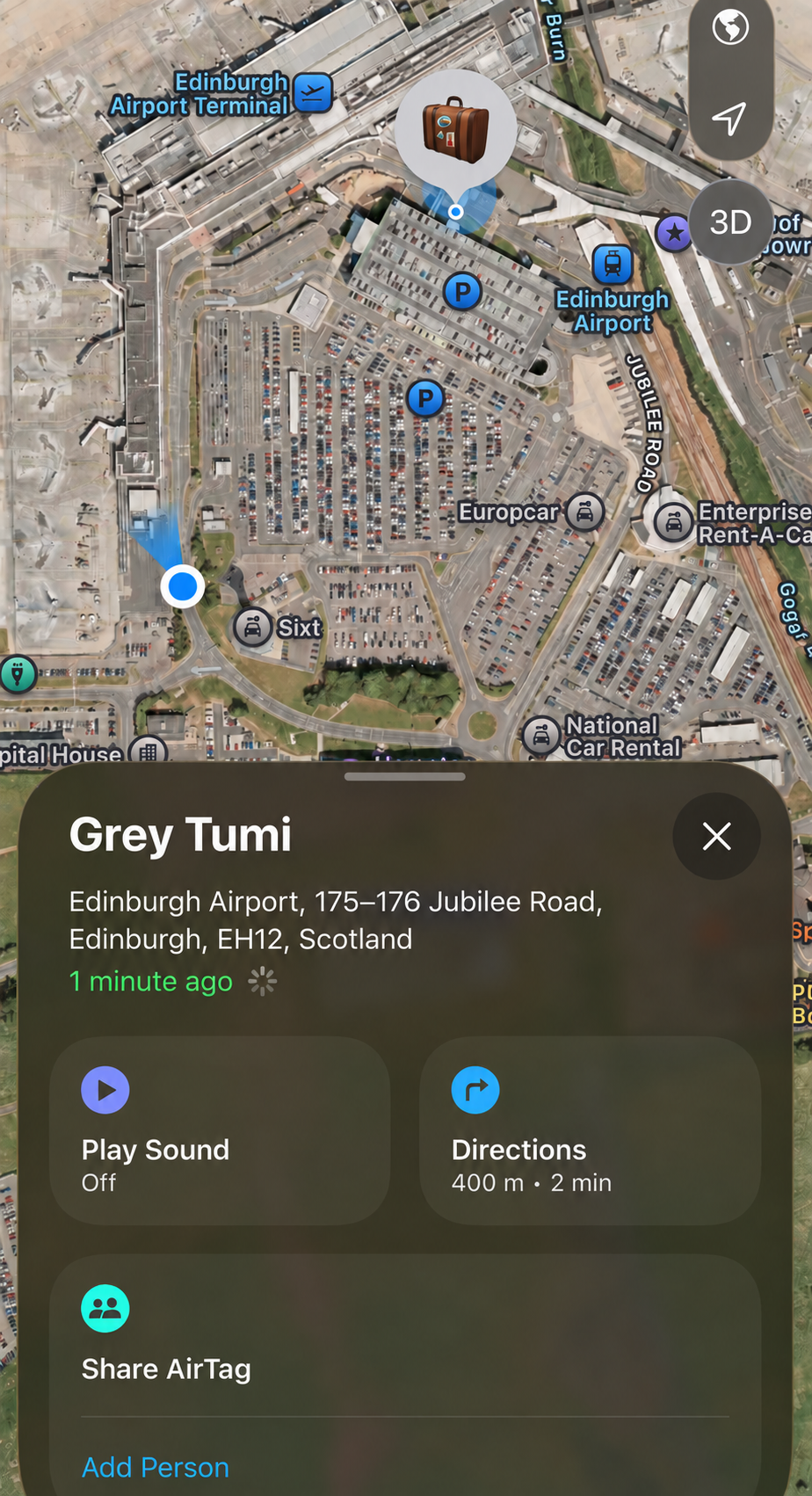
Tracking down the bag at Edinburgh airport
Eventually, I found the right staff, who took me through to the lost baggage area, and there it was. Finally Reunited!
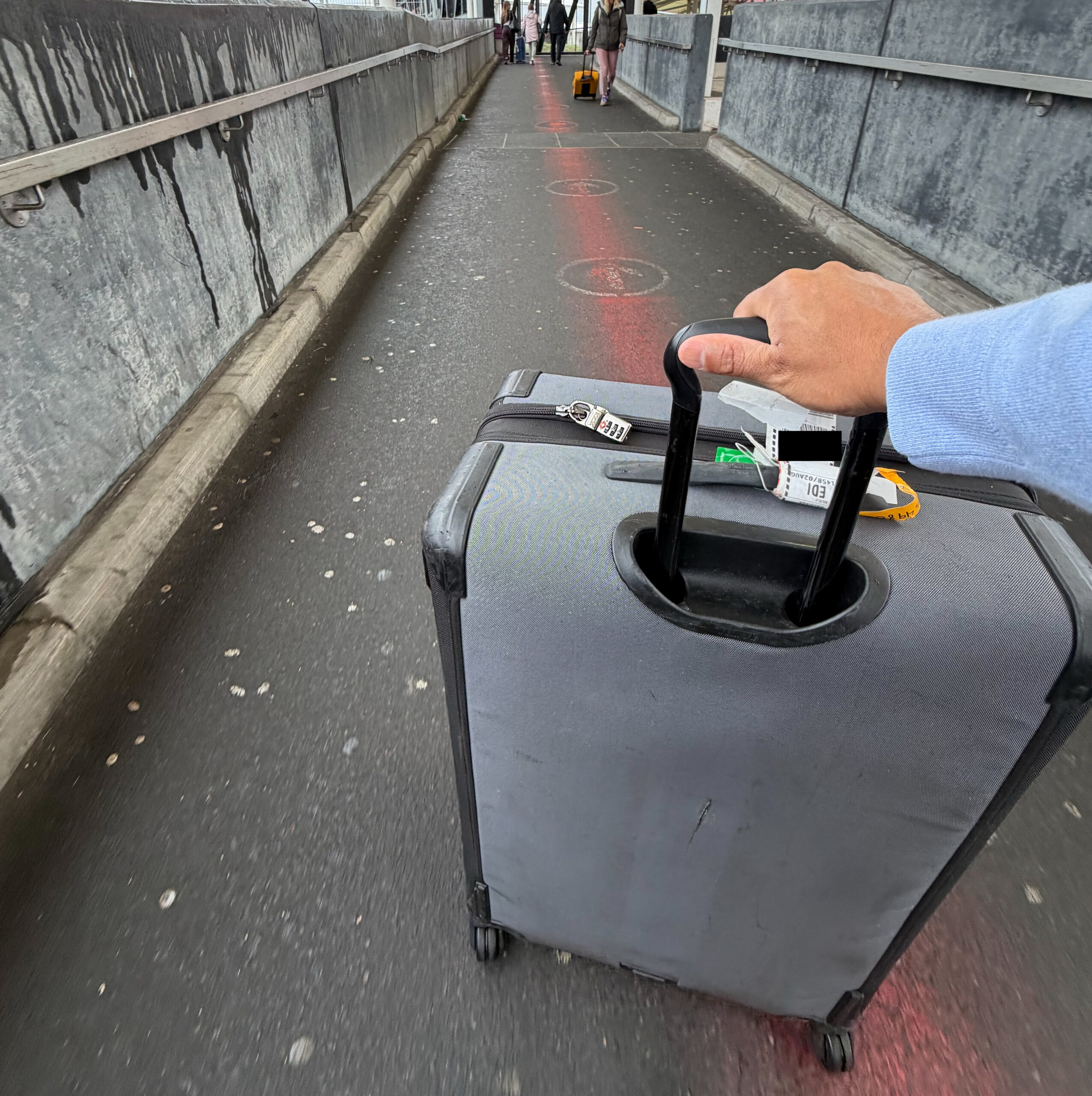
Reunited with my bag at Edinburgh Airport!
The Insurance Side
I had booked my Porter flight using Alaska Atmos points and paid the taxes with my Bank of America Atmos Rewards Summit Visa Infinite card, so I knew I had baggage delay coverage on that ticket. The Virgin Atlantic flight, however, was booked with Virgin points, with the taxes paid using my Chase Sapphire Reserve to earn 4X Ultimate Rewards points. I was less certain about the coverage on that award ticket, although the Chase insurance terms state that baggage and trip delay coverage applies when “all or a portion” of the common-carrier fare is charged to the card. Ultimately, though, I made the claim through the Summit card because that was the card used for the Porter ticket, where the baggage delay originated.
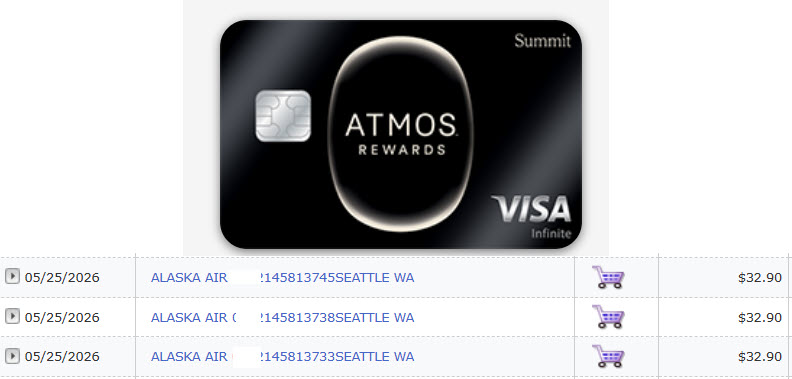
Atmos Rewads Summit Card with the flight charges
Reading through the Summit coverage, it provided up to USD $100 per day, per person, for eligible delayed baggage expenses, and importantly, award tickets were covered when booked using Atmos points and the applicable taxes were charged to the card. While I normally put my airline taxes on the Chase Sapphire Reserve, Atmos bookings are the one exception because the Summit card waives the $25 non-refundable partner booking fee, which not only saves me money but also makes cancellations effectively free.
The one thing that made me uncertain was that this wasn’t a single itinerary. Technically, Porter’s responsibility was only to get my bag to Toronto, and the bag actually arrived there on the next flight that evening, just too late to make our Virgin flight. If the delay were measured only until the bag reached Toronto, it was just a few hours and likely wouldn’t qualify. On top of that, the receipts I would be submitting were for purchases made in the UK, a destination I had reached using a completely separate ticket that wasn’t charged to my Summit card. Given that uncertainty, we bought only the bare minimum clothing we needed.
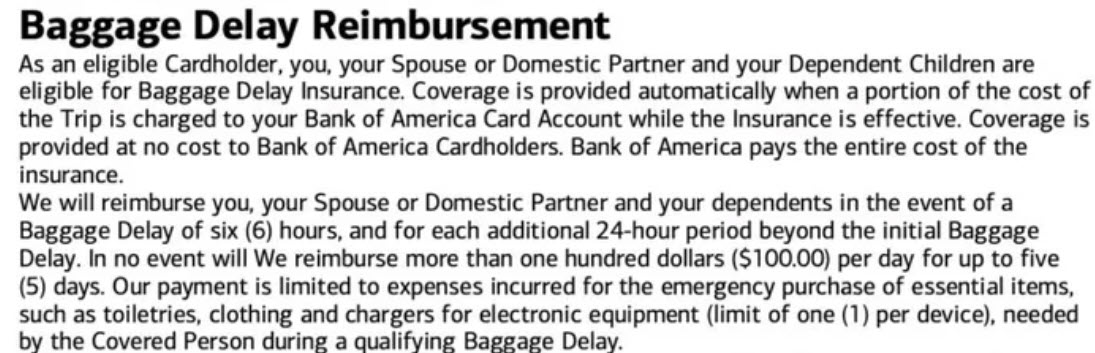
Baggage Delay Benefit – Atmos Rewards Summit Visa Infinite (Bank of America)
I’ve also never really understood the corner of the points-and-miles world that gets excited when a bag goes missing because it means an insurance-funded shopping spree. Yes, getting reimbursed for replacement clothing is much better than paying for it yourself, but spending part of your vacation dealing with baggage desks, emails, WhatsApp messages, replacement purchases and constantly checking an AirTag is hardly a win. I’d much rather have my suitcase arrive with me every time.
I submitted the claim a few weeks after returning home, and the process was surprisingly easy to complete online. About a week later, I was reimbursed for some of the clothing we had purchased, with no additional questions asked! I was genuinely impressed with how smoothly it worked.
Why This Worked So Well
Looking back, I think a big reason this was resolved so quickly is that each step happened almost exactly as it needed to. Porter located the bag quickly, created the PIR and was willing to hand it over to Virgin. Virgin, in turn, was willing to take responsibility for a bag that had never been checked with them and move it across the Atlantic on a completely separate ticket. Once the handoff happened, both airlines were also surprisingly responsive, which meant there was very little time lost waiting for someone to figure out who was responsible.
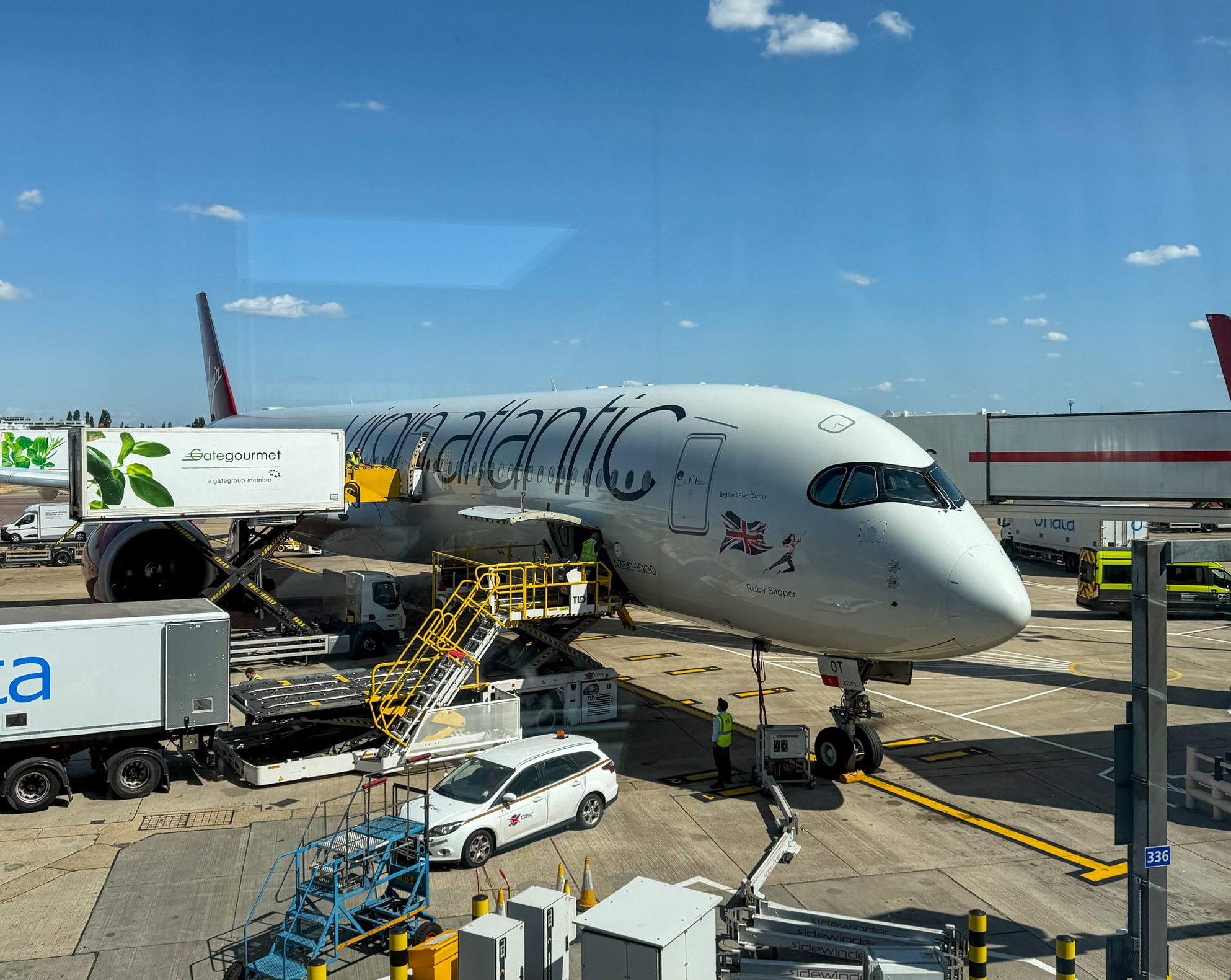
Virgin Atlantic A350-1000
The AirTag helped as well, even though it obviously couldn’t move the bag for me. At every stage I could see whether what I was being told matched where the suitcase actually was. I knew it was still in Ottawa, then saw it reach Toronto, Heathrow and eventually Edinburgh. That took a lot of the uncertainty out of the process and also meant I knew when it was worth following up.
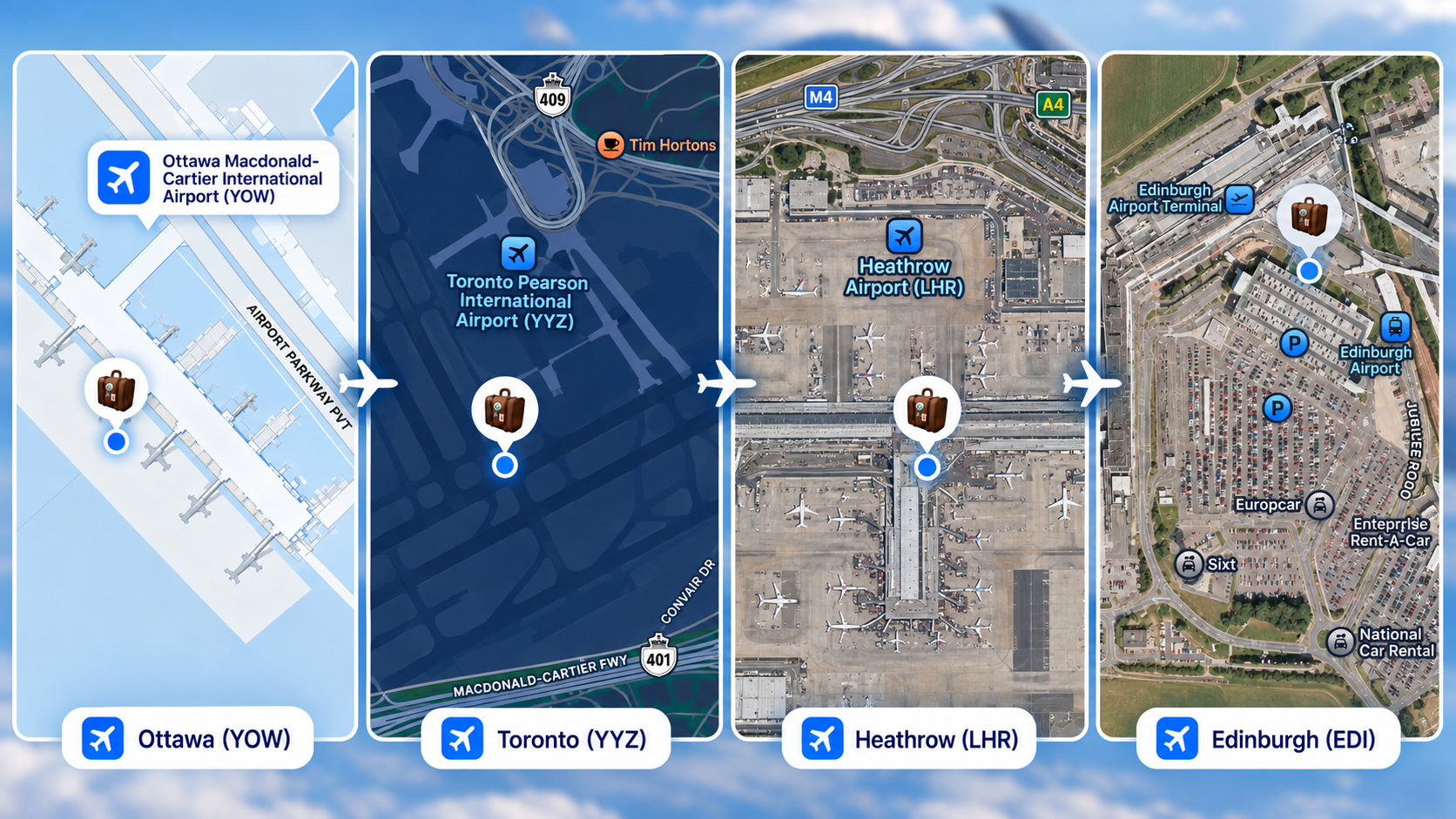
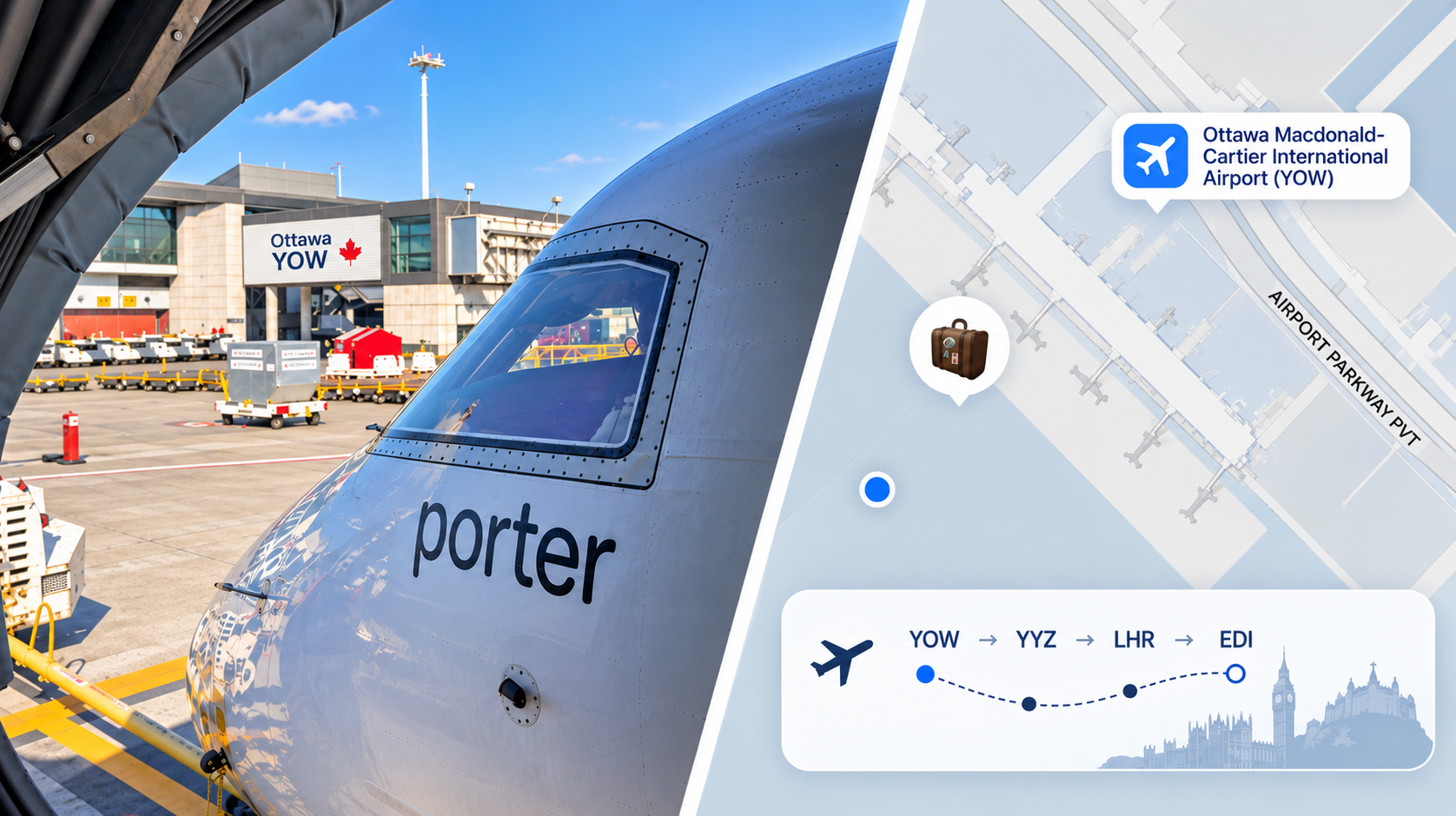
Tracking the Bag Across Four Airports
More than anything, though, I think there was an element of luck. The bag reached Toronto that evening, Virgin had space to move it to London the next night, and then they were able to forward it to Edinburgh the same day. Any one of those steps could easily have taken another day or two. Several friends who have dealt with delayed baggage told me afterward that getting a suitcase back this quickly, especially across multiple airlines and separate tickets, was a much better outcome than I should have expected.
What I’d Tell You to Do Differently
Looking back, there are a few things I would do differently, or at least pay more attention to, the next time I travel on separate tickets with checked luggage:
- Don’t assume the impossible won’t happen. Out of hundreds of flights over the past 20 years from Ottawa, I’ve never had a bag not make it onto the flight until now. There’s a first time for everything, and this was mine.
- Maximize your carry-on essentials. Not just a few days of clothes, but also jackets, footwear, medications and valuables. Your carry-on should always be as full as possible with the things you really don’t want to be without.
- Watch the single-bag trap. Consolidating 3 people’s essentials into one checked bag is efficient right up until that bag becomes a single point of failure. Perhaps checking more bags is actually the better strategy?
- Put an AirTag in every checked bag. In 2026, this almost goes without saying if you’re a frequent traveller. While it didn’t solve our problem, it gave me some peace of mind knowing where my bag was almost every step of the way. Plus, the ability to share your AirTag location with the airline is a nice bonus.
- Know your baggage delay coverage before you need it. This was an oversight on my part, and I got lucky. Best practice is to know what your card covers beforehand. The separate-ticket situation created enough uncertainty that I wasn’t completely sure how the claim would be handled until it was approved.
- Build in more buffer than you think you need. Our 5-hour connection did exactly what it was supposed to do and protected us from missing the Virgin flight. It just wasn’t enough time to solve a baggage problem that started back in Ottawa. In the future, I’d position even earlier.
Final Thoughts
This whole situation ended far better than I expected. Our bag was left behind in Ottawa on a completely separate Porter ticket, yet somehow made it to Toronto, was handed over to Virgin, flown to London and then forwarded to Edinburgh. Porter and Virgin both deserve credit, but the bigger lesson is that separate tickets really do mean separate journeys, not just for you, but for your baggage as well. None of this happened automatically. It worked because both airlines were willing to cooperate and because I stayed on top of the process.
I also realized I’m probably too casual about travel insurance and tend to assume I’ll be covered without reading the fine print. I got lucky this time with both the baggage recovery and the claim. In the end, the positioning strategy still did its job and got us onto our Virgin flight, but this experience reminded me that with separate tickets, you’re not just risking missing the next flight. You are also taking on the risk that your bag may not make the connection with you.