Table of Contents
Points Miles and Bling (blog) contains referral or affiliate links. The blog receives a small commission at no additional cost to you. Thank you for your continued support. Credit Card issuers are not responsible for maintaining or monitoring the accuracy of information on this website. For full details, current product information, and Terms and Conditions, click the link included.
Are Preferred Seats worth paying for? We compare exit rows, bulkheads, extra legroom, pricing, and when airline Elite status can get them free.On just about every aircraft from every airline, you’ll find regular economy seats alongside extra-legroom seats that airlines sell for an additional fee, include in bundles with other services, or offer complimentary with airline status. Some offer a few extra inches of space, while others are just located at the front of the cabin.
Every airline distributes and monetizes these seats a bit differently, but the core concepts are the same. Using Air Canada as an example, let’s take a look at what they are, the different types of preferred seats, when it’s worth paying the upcharge, and how to receive them complimentary.
Not All Preferred Seats Are Created Equal
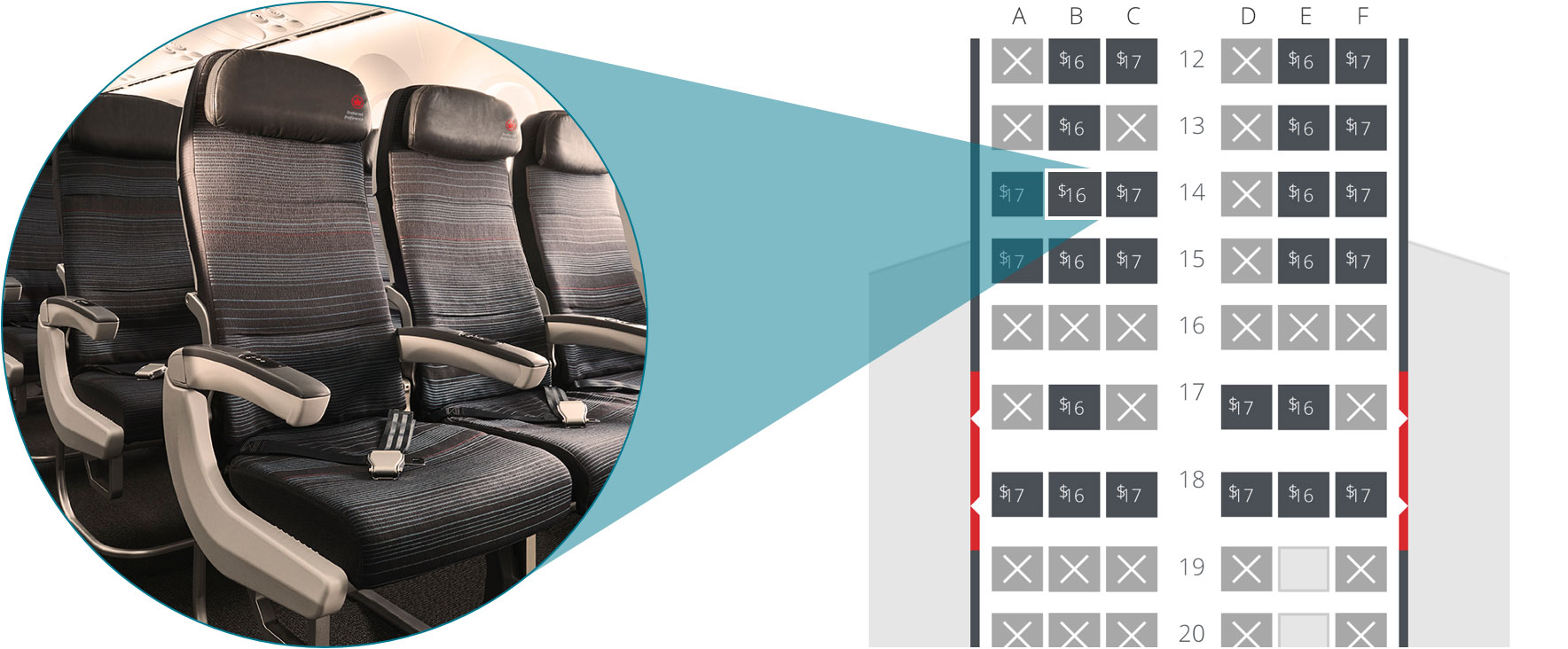
Air Canada designates exit rows, select bulkhead rows, and some seats near the front of Economy as Preferred Seats. Preferred Seats also come with Zone 3 boarding, but keep in mind premium Aeroplan co-branded cards like the TD Aeroplan Visa Infinite Privilege include Zone 2 as a benefit. Therefore, the seat itself is very much the main attraction.
Air Canada advertises up to four inches of additional space with Preferred Seats, but it isn’t a universal metric across aircraft or even on the same plane. Depending on the location of the Preferred Seat, the amount of additional legroom varies.
Every Preferred Seat on Air Canada comes with additional legroom, but some airlines designate seats as preferred simply because they’re located at the front of the Economy cabin.
Exit Rows Can Be Fantastic, With Caveats
If legroom is the priority, I’d generally look at exit rows first.
Some give you a few extra inches, while others have enough open space that you can fully stretch your legs. That’s a meaningful difference on a long-haul flight, particularly compared to a regular Economy seat.
There are trade-offs, though. Some exit-row seats have limited or no recline, particularly when another exit row is immediately behind them. You may also find immovable armrests that contain the tray table, and you’ll need to put your bags in the overhead bin during takeoff and landing when there’s no seat directly ahead.
Then there are some (wonderfully) strange aircraft configurations.
Depending on the aircraft, you can find rows that narrow from three seats to two around an emergency exit. The seat behind the “missing” seat will have what feels like unlimited legroom. The caveat is there’s often a rear-facing jumpseat for flight attendants in that space, leading to awkward eye contact during takeoff and landing, but I’ll take that trade-off any day.
I prefer that solo Preferred Seat when flying alone and the two-seat row when flying with my partner. The legroom isn’t as generous as the row behind, but neither of us has to sit with a stranger.
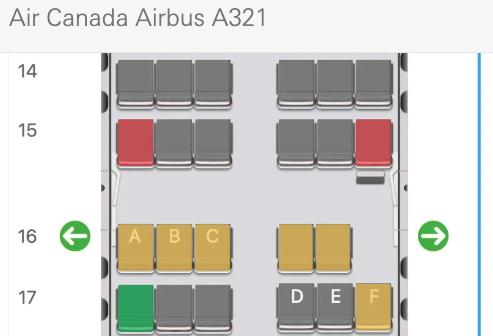
My favourite solo seat is 17F, my favourite seat when travelling with my partner is 16D and 16E (screenshot from AeroLOPA)
Bulkheads Aren’t Necessarily Better
Bulkheads are another common type of Preferred Seat, but I think they come down more to personal preference.
There’s no seat directly in front of you, which means nobody reclining into your space and generally more knee room. However, there’s also no space underneath the seat ahead to stretch your feet into.
Bulkheads can also have fixed armrests, and your personal item needs to go overhead during takeoff and landing.
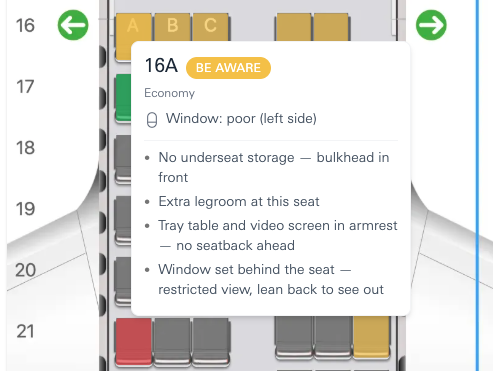
Not everyone likes bulkhead seats (screenshot from AeroLOPA)
I’d therefore avoid assuming that a bulkhead is automatically better. I’m on the short side, so the lack of legroom in front doesn’t bother me, and it’s nice to not have anyone reclining into my space.
On some planes, the bulkhead row has a seat that protrudes into the aisle, and I’d avoid that seat since you may find your knee hitting the beverage cart during service.
A Dash 8 Preferred Seat Isn’t a Boeing 787 Preferred Seat
Aircraft and flight length should probably be the biggest considerations after the seat itself.
Paying for a Preferred Seat on a one-hour Dash 8 flight between Toronto and Ottawa is fundamentally different from selecting an exit row for an eight-hour overnight flight to Europe.
If I’m paying $80 for a spacious exit row on an eight-hour flight, that’s effectively $10 per hour for substantially more room. I can make a pretty good case for that.
Paying $40 for a marginally better seat on a one-hour flight is much harder to justify.
There are exceptions. Sitting near the front could be valuable if you have a tight connection, for example. But generally, the longer the flight and the greater the physical difference between the Preferred Seat and a regular seat, the easier it is to justify paying.
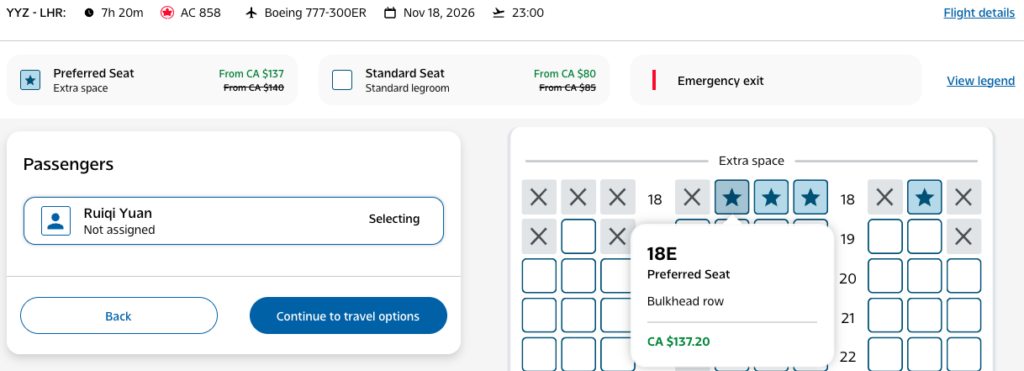
$137 over 7.5 hours is equivalent to paying $18.27 per hour of flight time
I’d also look at a detailed seat map before spending anything. Air Canada’s seat map identifies Preferred Seats, but AeroLOPA shows the actual cabin layout in much greater detail, including doors, bulkheads, lavatories, windows, and unusual exit-row configurations.
Preferred Seats Are a Fantastic Elite Perk
Preferred Seats are also one of the most underrated Aeroplan Elite Status benefits, in my opinion.
Aeroplan 25K and 35K members can access complimentary Preferred Seats at check-in on eligible (non-basic) fares, while higher-tier members receive progressively broader access. As a 25K member on a Standard Economy Aeroplan redemption, I usually receive an automatically assigned Preferred Seat at online check-in, but changing to another Preferred Seat incurs a cost.
Most notably, there’s no credit card substitute for this benefit. For example, premium Aeroplan credit cards offer benefits such as access to the Maple Leaf Lounge and priority airport services.
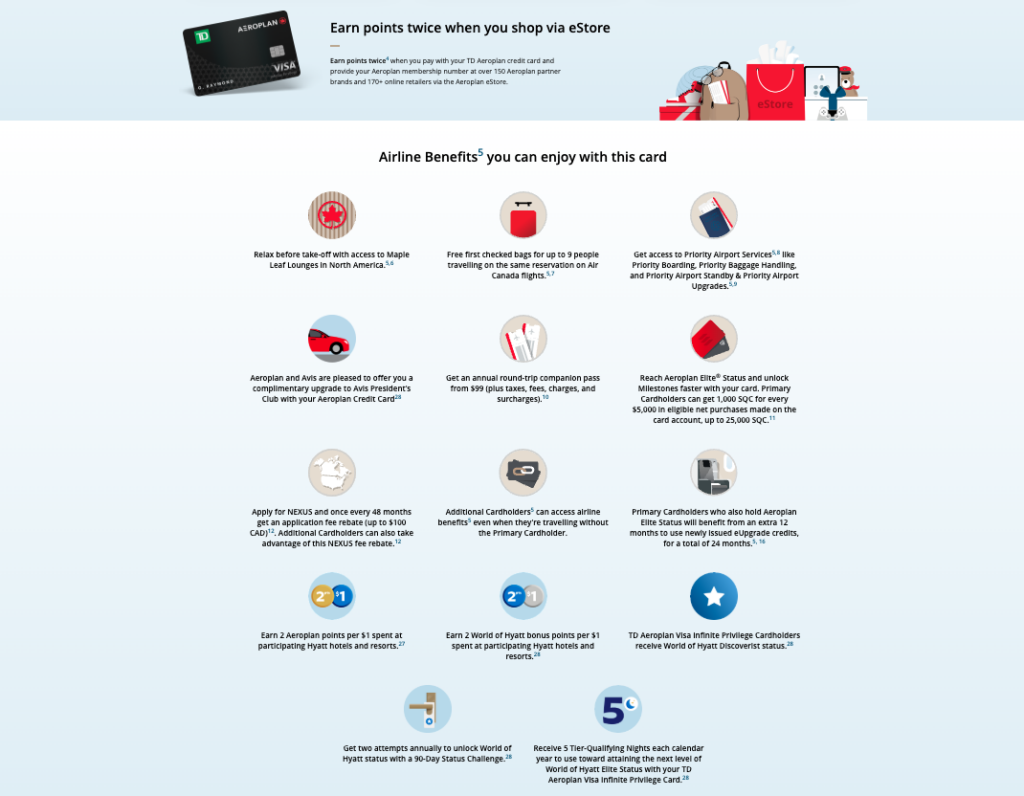
No credit card includes complimentary Preferred Seats
I wouldn’t necessarily value the benefit at whatever Air Canada happens to be charging, since there’s a difference between a $100 price tag and actually being willing to pay $100. But if you routinely pay for extra-legroom seats anyway, Preferred Seat access can add hundreds of dollars of value over a year.
It’s actually my favourite perk of Aeroplan 25K status.
While complimentary Preferred Seats are not a published benefit of alliance Elite status, whether Star Alliance Gold, Oneworld Sapphire or Emerald, or SkyTeam Elite Plus, you’ll often find that status still helps in practice. At the very least, asking a Finnair check-in agent for an exit row is more likely to work in your favour if you’re Oneworld Emerald.
Takeaway
Not all Preferred Seats are created equal. I’d happily pay for a spacious exit row on a long-haul flight, while a seat that’s simply closer to the front of Economy is much harder to justify.
Ultimately, look at the specific seat, aircraft, flight length, and price rather than the “Preferred” label. Better yet, airline Elite status can take the price out of the equation by including Preferred Seats as a complimentary benefit.
