Table of Contents
Points Miles and Bling (blog) contains referral or affiliate links. The blog receives a small commission at no additional cost to you. Thank you for your continued support. Credit Card issuers are not responsible for maintaining or monitoring the accuracy of information on this website. For full details, current product information, and Terms and Conditions, click the link included.
In short, the UK government charges the highest departure taxes for airline passengers in the world, called the UK Air Passenger Duty (APD). Exactly how much it costs depends on the cabin class and the flight distance; for perspective, the current price is about $458 CAD for a business class transatlantic flight departing from London. This is purely the APD, so you’ll also have your usual airport taxes and fees on top of that.
When redeeming miles or points, you’re still on the hook for the taxes and fees, which means you will be paying the UK APD. This is the main reason long-haul flights out of London have such expensive cash components. Of course, flying with British Airways often includes the double whammy of high fuel surcharges (charged by BA) and UK APD.
All About UK APD
The Price of UK APD
First, the UK determines the APD distance band using the capital city of your destination country, not necessarily your final destination. Second of all, economy passengers pay the Reduced Rate, while all other cabin classes pay the Standard Rate. With that understanding, the following chart depicts the UK APD prices.
| Distance | Reduced Rate | Standard Rate |
|---|---|---|
| England, Scotland, Wales, and Northern Ireland (Domestic) | £8 (~$15 CAD) | £16 (~$30 CAD) |
| 0–2,000 miles (Band A) | £15 (~$28 CAD) | £32 (~$60 CAD) |
| 2,001–5,500 miles (Band B) | £102 (~$191 CAD) | £244 (~$458 CAD) |
| 5,500+ miles (Band C) | £106 (~$199 CAD) | £253 (~$475 CAD) |
The UK APD is updated every year on April 1, so here are the 2027 prices.
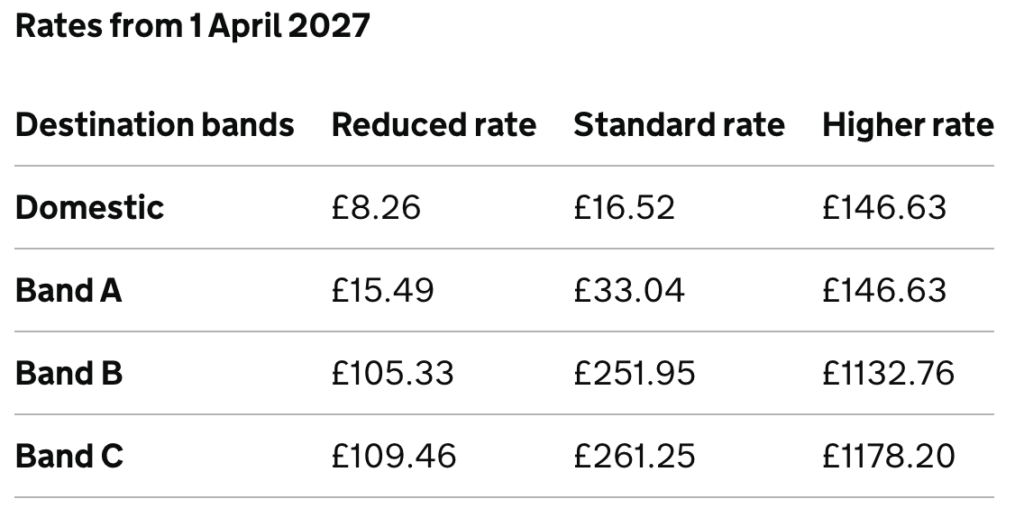
Higher Rate is for mostly non-commercial traffic, with one example being private jets.
Which Itineraries Have UK APD
To put it simply, the UK charges Air Passenger Duty (APD) when your itinerary originates in the UK or includes a stopover in the UK of more than 24 hours. If you’re flying to the UK as your destination or connecting through the UK for less than 24 hours, APD does not apply.
The exact Band of APD charged is based on the part of your trip that originates in the UK. If you fly from Toronto to London, have a 3-day stopover, then fly in business class from London to Geneva, you’ll pay the Standard Rate for Band A, which is £32. Had your trip terminated in London or connected onward within 24 hours, APD would not apply.
If you fly from Paris to London on one ticket and then book a separate business class ticket from London to New York departing three hours later, you’ll pay the Standard Rate for Band B, which is £244. In this case, APD applies even though your stop in the UK is under 24 hours because the airline charges APD when it issues the ticket. For all intents and purposes, that ticket originates in the UK.
If you fly from London to Vancouver with a two-hour layover in Paris on one ticket, you’ll still pay the long-haul UK APD. Because your stop in Paris lasts less than 24 hours, your trip originated in the UK, with Vancouver as the destination.
Finally, you might try to avoid the higher APD by booking an economy ticket and upgrading to a higher cabin class — well, this does work sometimes. If you pay to upgrade to business class, you’ll be on the hook for the higher taxes. However, operational upgrades and non-cash upgrades, such as eUpgrades, do not trigger any additional taxes.
UK APD Exemptions
Although it is few, there are exemptions to the UK APD. Children under 2 are exempt in all circumstances and children under 16 are exempt when flying economy class.
Flights originating in the Scottish Highlands are fully exempt from APD and flights from Nothern Ireland are exempt if flying directly to a destination that’s over 2,000 miles away (outside Band A). The Scotland trick comes in handy, while the Northern Ireland one isn’t super useful since there aren’t long-haul direct flights originating there.
Avoiding the UK APD
Start in Inverness
Notably, Inverness is in the Scottish Highlands and you’re fully exempt even when connecting through London. Flying from London to Inverness is fairly cheap and avoids the $400+ APD charge.
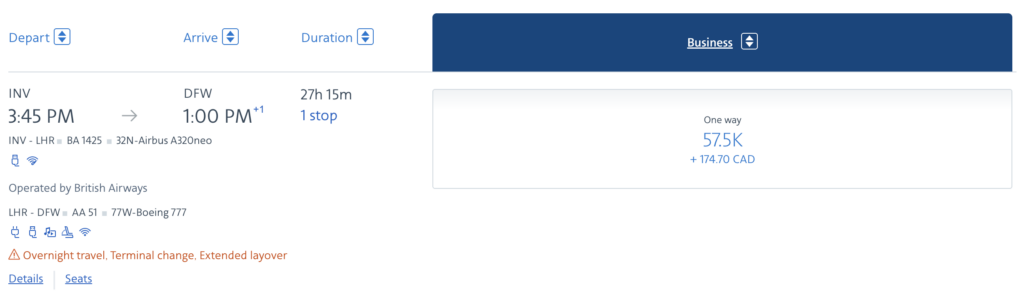
Save $400+ by originating in Inverness instead of London
The fees are just $174.40 CAD because the long-haul flight is on American Airlines. If it were on British Airways, the fees would still be $700+, not due to APD, but the high fuel surcharges British Airways levies.
Position to Another Country
Like Inverness, you can avoid UK APD by taking a (or a series of) positioning flight/train/bus/ferry to another country. The easiest/cheapest option is usually Dublin, as flights from London to Dublin can be as cheap as $30.
If you have more time on your trip, the ideal case is simply to visit another country and then start your journey home from there. Purely from a cost-saving perspective, destinations such as France and Germany aren’t ideal either. While their departure taxes are lower than the UK’s Air Passenger Duty, the savings would likely disappear once you factor in the additional cost of getting there.
Build a Stopover
The UK charges Air Passenger Duty (APD) based on travel originating in the UK and ending at your next stopover of at least 24 hours. That is, once you have a stopover of 24 hours or more, your trip effectively ends in that stopover city for UK APD purposes.
Also, UK APD for short-haul flights is considerably lower than for long-haul flights. When all in business class, flights under 2,000 miles incur £32 of APD, while flights of 2,001–5,500 miles incur £244 of APD.
Therefore, you can take advantage of frequent flyer programs that allow stopovers on one-way tickets (Aeroplan, Air France KLM Flying Blue, and Alaska Atmos Rewards, just as examples) and add a stop on your journey home from London. If you book a Flying Blue ticket from London to Toronto via a 24-hour stop in Amsterdam, you’ll only be charged £32 of APD (for the London to Amsterdam segment).

Reduce your APD by spending 24 hours in Amsterdam
Book on Separate Tickets
The same principle also works with separate tickets. This works best if you’re starting in London, but have a layover elsewhere in Europe before your long-haul segment. In the London–Paris–Vancouver example mentioned earlier, you would only be charged short-haul APD if you bought separate tickets for London–Paris and Paris–Vancouver.
Aer Lingus has generous award space across the Atlantic, and you can avoid APD by booking London–Dublin and Dublin–North America as separate tickets, paying a small sum of cash or Avios for the sub-90-minute flight.
In my opinion, booking a one-way flight on separate tickets is the best compromise regarding UK APD, since you’re not “wasting” additional time on any extra positioning flights, but of course this doesn’t work if your long-haul flight departs from the UK.
Takeaway
The UK APD is a (very high) tax levied on passengers departing the UK or when stopping in the UK for over 24 hours. While it’s built into the fare on cash tickets, you still have to pay some $400+ of APD when paying for your ticket with miles or points.
With a few clever tricks, UK APD can be avoided or greatly reduced, such as starting your trip in Inverness, Dublin, or another European country. The easiest way to minimize APD is to book your long-haul flight departing from another European country on a separate ticket, so your ticket departing from London is for a short-haul flight.
However, you do have to keep in mind any additional costs if you have to reposition to another country (especially if an overnight stay is required) and the extra time it takes. I reframe it as visiting another destination on my trip. 🙂

4 comments
Great information thanks
Hope it comes in handy for you at some point :))
Very useful information…thank you
Glad you found it helpful!