
Table of Contents
Points Miles and Bling (blog) contains referral or affiliate links. The blog receives a small commission at no additional cost to you. Thank you for your continued support. Credit Card issuers are not responsible for maintaining or monitoring the accuracy of information on this website. For full details, current product information, and Terms and Conditions, click the link included.
On March 23, Porter raised the fuel surcharge on all VIPorter redemptions to $40 one-way. Exactly 3 months later, on June 23, Porter reduced the fuel surcharge to $20. Less than a month later, on July 18, Porter raised the fuel surcharge back to $40 one-way.
The increase is intended to offset the rise in global fuel prices and was applied to all award bookings. The idea was that, with this increased fee, Porter would not need to raise the number of points required per redemption.
Most importantly, Porter had always reported it as “temporary”, even if I had personal doubts whether it really would decrease, should oil prices stabilize. Back in March, Porter did not provide any benchmarks. Mostly, I have trouble imagining airlines giving up extra revenue once customers have been shown to absorb the increased costs. Given Porter did decrease the fuel surcharge to $20 at one point, I have hope that this $40 price really is temporary and the fuel surcharge will decrease or be removed altogether when oil prices stabilize.
It’s now labelled “Air transportation charges” instead of “Peak surcharge”
What’s really interesting is the way the fee is applied. When it was first rolled out, it was displayed as “Peak surcharge”, as you can see from the screenshot below.

One-way Peak Surcharge for YYZ-YVR
When searching the same flight today, the “Peak surcharge” is gone, while “Air transportation charges” are $40 more.
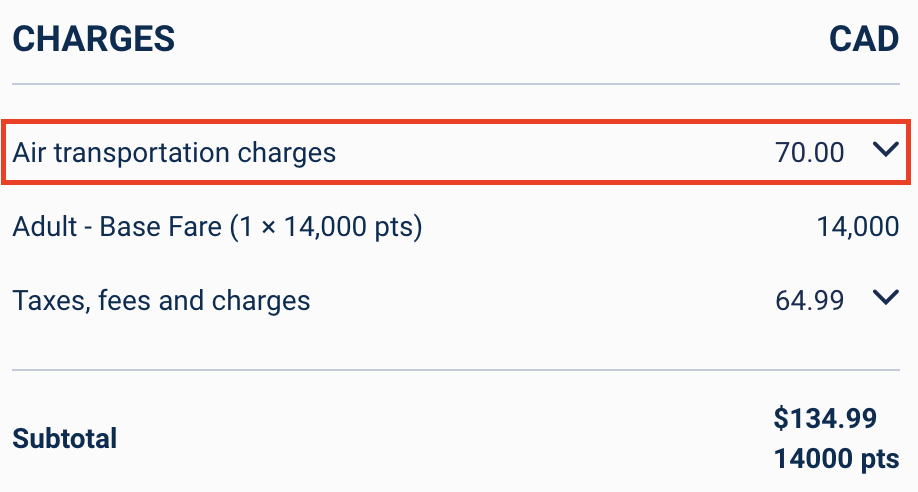
The “Air transportation charges” is $40 higher, while Peak Surcharge is removed
It’s the same case with a flight from Toronto to Boston.

One-Way Peak Surcharge YTZ-BOS
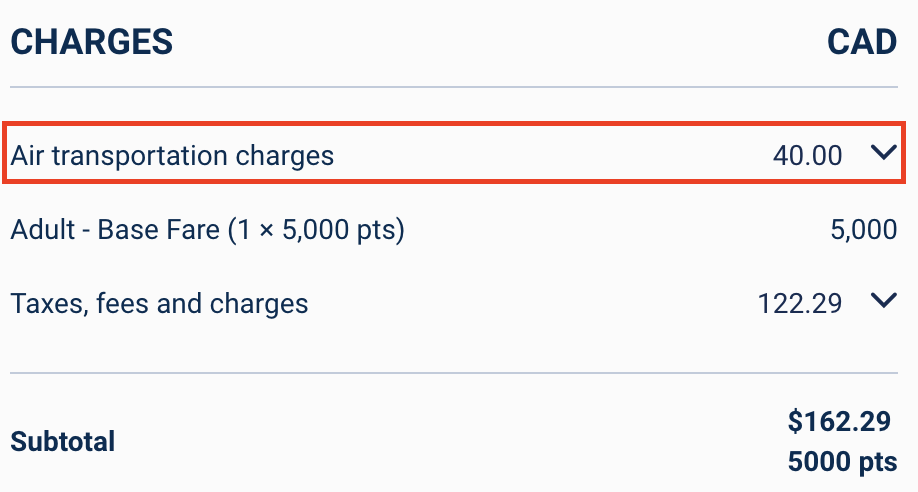
The “Air transportation charges” is $40 higher, while Peak Surcharge is removed
What’s interesting is while fuel surcharges are the same as originally at $40, the overall taxes & fees still increased $13.45. Most fees went up a little, which I had presumed was due to the current weaker Canadian dollar, but the “Airport Improvement Fee Deposit” increased from $29 to $45.20. As these are standard government taxes, it must be that many airports across Canada increased their “Airport Improvement Fee”.
Notably, the same flights booked through partner programs like Alaska Atmos do not incur peak fuel surcharges. For example, the same YYZ-YVR flight redemption using Alaska Atmos looks like this;
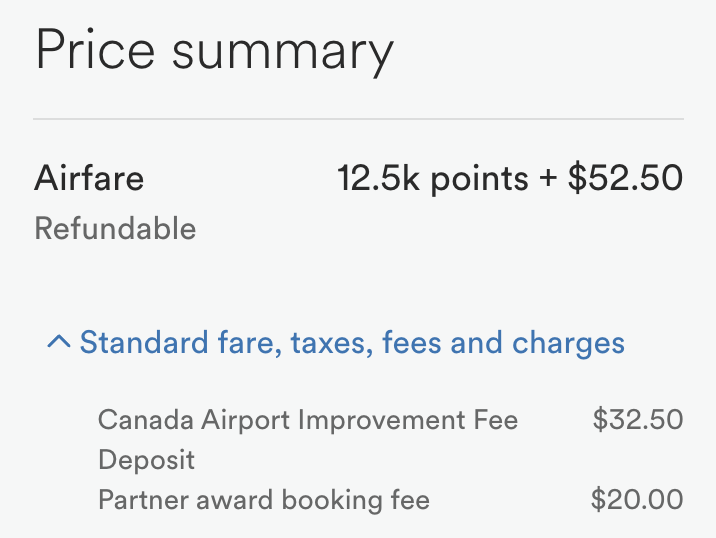
One-way Atmos Redemption: YYZ-YVR
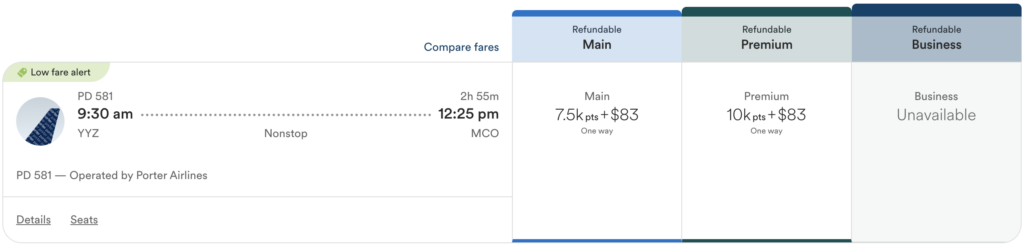
For Canadians travelling domestically and transborder, redeeming Alaska Atmos on Porter Airlines is a great sweet spot. For example, redeeming for Porter Reserve on E195-E2 aircraft, which is priced as a premium economy product, lets you fly from Ontario to Florida for just 2,500 points more than economy. Note partner booking fees do apply at $20 per passenger.
Takeaway
Porter’s $40 fuel surcharge is back, but the fact that it already dropped once gives me some confidence that it really is temporary. In the meantime, redeeming Atmos Rewards for Porter flights remains a great way to avoid the surcharge altogether.


2 comments
Any one running the numbers may be scratching their heads with the implementation of this. It’s a flat $40 fee per person per direction for flights in Canada or to the U.S. regardless of distance. And a flat $86 to Mexico, Caribbean, and Cancun. Toronto to Cancun is over 400nm shorter than Toronto to Los Angeles and yet the fee is more than double….
Ha! Good observation on the CUN v LAX distance from YYZ. I guess a linear levy on awards was an easier IT lift than a dynamic once based on distance.